
Recent news about an alleged affair involving South Dakota governor Kristi Noem and political strategist Corey Lewandowski has sparked a familiar debate among Christians: Did Jesus allow divorce for adultery? Or has this teaching been misunderstood over time?
Marriage and divorce remain among the most debated topics in Christianity. Many people assume the Bible clearly teaches that divorce is allowed when a spouse commits adultery. In fact, this belief is common in many Christian churches today.
However, when we examine the biblical passages more closely—along with the Greek language used in the New Testament and the early Christians’ historical interpretation—the issue becomes more complex.
Did Jesus actually allow divorce for adultery, or has His teaching been misunderstood?
To answer this question, we must carefully examine the passages in which Jesus addresses divorce.
Jesus’ Teaching on Divorce in the Gospels
Jesus speaks about divorce directly in several places in the New Testament:
-
Matthew 5:32
-
Matthew 19:3–9
-
Mark 10:2–12
-
Luke 16:18
When the Pharisees asked Jesus whether divorce was permissible, He did not begin with legal arguments. Instead, He pointed back to the creation account in Genesis.
Jesus said:
“Have you not read that He who created them from the beginning made them male and female… Therefore what God has joined together, let no man separate.” (Matthew 19:4–6)
By returning to creation, Jesus emphasized that marriage was designed by God to be a permanent union between husband and wife.
This teaching was radical in the ancient world. In first-century Judaism, some teachers allowed divorce for trivial reasons. One well-known rabbinical school even permitted divorce if a wife spoiled a meal.
Jesus rejected this cultural norm and restored marriage to its original dignity and permanence.
Why Many Christians Believe Jesus Allowed Divorce
Despite Jesus’ strong statements about the permanence of marriage, many Christians believe He allowed divorce in certain circumstances. This belief comes primarily from the Gospel of Matthew.
In Matthew 19:9, Jesus says:
“Whoever divorces his wife, except for sexual immorality, and marries another commits adultery.”
Most modern Bible translations render the Greek word porneia as “sexual immorality.” Because adultery is a form of sexual immorality, many readers conclude that Jesus allows divorce when adultery occurs.
Under this interpretation, Jesus’ teaching is understood as follows:
-
Marriage is intended to be lifelong.
-
Adultery represents a serious violation of the marriage covenant.
-
Because the covenant has been broken, the innocent spouse may divorce and remarry.
Many Protestant traditions also refer to 1 Corinthians 7:15, where the Apostle Paul addresses situations in which an unbelieving spouse abandons a believer. Some interpret this passage as allowing divorce in cases of abandonment.
As a result, many Protestant churches recognize two possible grounds for divorce:
-
adultery
-
abandonment by an unbelieving spouse
This interpretation became especially influential during the Protestant Reformation, when reformers such as Martin Luther and John Calvin argued that Scripture allows divorce under certain circumstances.
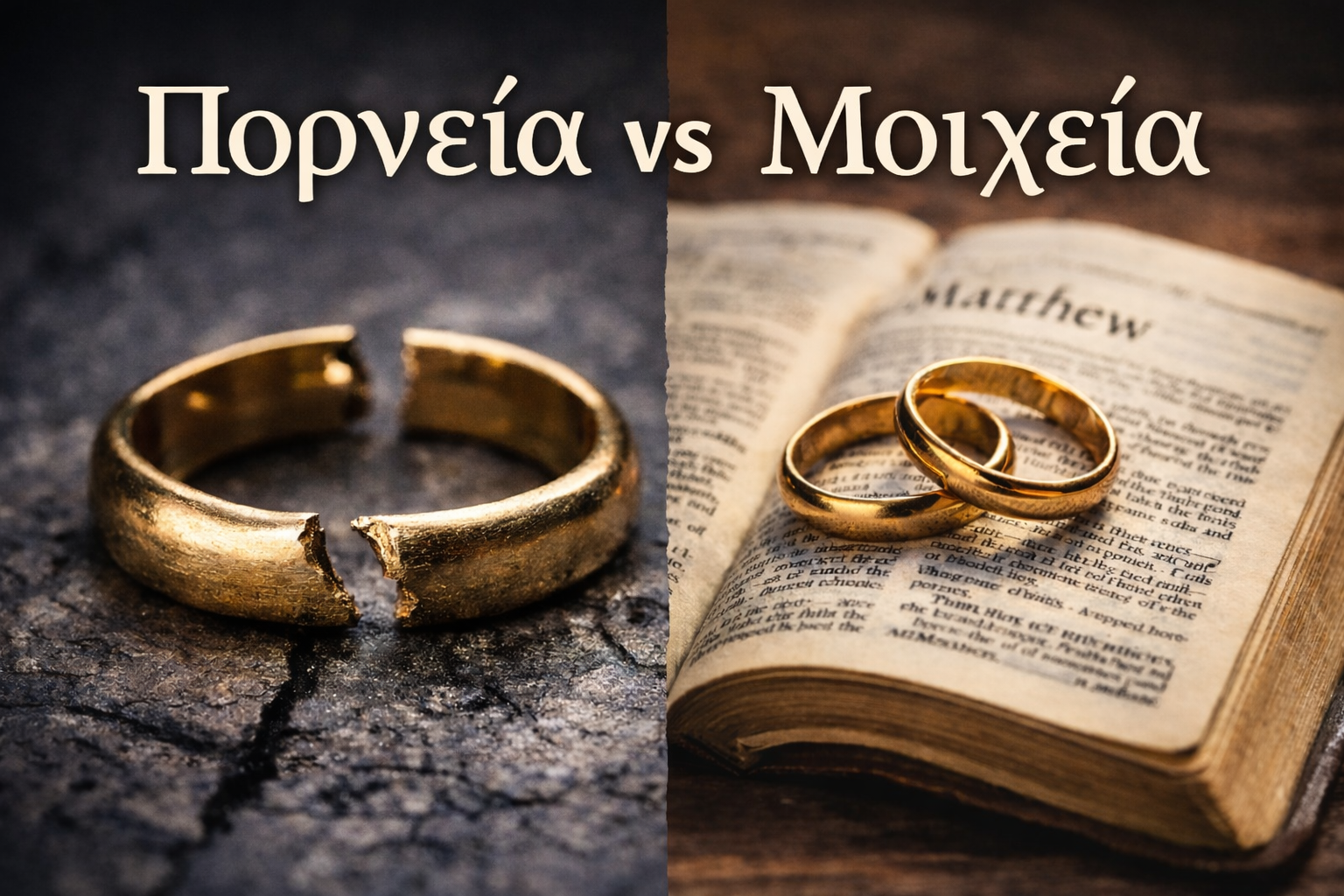
Porneia vs Adultery: Understanding the Greek Words
Understanding the Greek word porneia is central to interpreting Matthew 19. The debate about divorce in Matthew’s Gospel ultimately centers on the meaning of a single Greek word: porneia.
In the New Testament, two different Greek words are used when discussing sexual sin.
Moicheia (μοιχεία)
This word specifically refers to adultery, meaning sexual relations between a married person and someone who is not their spouse.
Porneia (πορνεία)
This word has a broader meaning and refers to sexual immorality or illicit sexual relationships.
The key detail is that Matthew records Jesus using the word porneia rather than moicheia.
Because of this distinction, some scholars argue that Jesus may not be referring to adultery within a valid marriage. Instead, the term may refer to unlawful unions that were never valid marriages in the first place.
These could include relationships prohibited under Jewish law, such as incestuous unions described in Leviticus 18.
If this interpretation is correct, then the exception clause in Matthew does not refer to divorce after adultery. Rather, it refers to separating from a relationship that should never have been considered a valid marriage.
Why Mark and Luke Do Not Include the Exception Clause
Another important observation is that the other Gospel writers make no exception at all.
In Mark 10:11, Jesus says:
“Whoever divorces his wife and marries another commits adultery against her.”
Similarly, Luke 16:18 records:
“Everyone who divorces his wife and marries another commits adultery.”
These passages contain no exception clause.
This raises an important question: if Jesus clearly allowed divorce for adultery, why would two Gospel writers omit such a crucial qualification?
One possible explanation is that Matthew’s reference to porneia addresses a specific situation relevant to his audience—namely, unlawful unions that were not valid marriages. Mark and Luke, writing for different audiences, simply present the core teaching of Jesus: that a true marriage cannot be dissolved.
In this way, the teaching of the four Gospels remains consistent.
How Early Christians Interpreted Jesus’ Teaching
The earliest Christian writers overwhelmingly interpreted Jesus’ teaching as affirming the permanence of marriage.
Church Fathers such as:
-
St. Augustine
-
St. John Chrysostom
-
St. Jerome
All taught that adultery is a grave violation of marriage, but it does not dissolve the marriage bond itself.
While separation could be permitted in serious circumstances, remarriage while a spouse was still living was generally considered incompatible with Jesus’ teaching.
Some early interpreters understood the word porneia as referring to unlawful unions rather than adultery within marriage.
Separation vs Divorce in Christian Teaching
Another important distinction is the difference between separation and divorce.
Christian tradition has long recognized that serious circumstances may require spouses to live apart. These circumstances could include:
-
adultery
-
abuse
-
abandonment
However, separation does not dissolve the marriage covenant.
The spouses remain married even if they no longer live together.
This understanding preserves Jesus’ teaching that marriage is meant to be a lifelong union.
Why Jesus’ Teaching Was So Radical
In the ancient world, divorce was often easy and common, particularly for men. Some Jewish teachers allowed divorce for trivial reasons.
Jesus challenged this cultural norm by returning to God’s original design for marriage.
“The two shall become one flesh.” (Genesis 2:24)
By grounding marriage in creation itself, Jesus elevated it from a social contract to a sacred covenant.
Conclusion – Did Jesus allow divorce for adultery?
Many Christians believe He did because of the exception clause in Matthew’s Gospel. However, when the passages are examined carefully—along with the Greek language and the broader context of the Gospels—the issue becomes more complex.
Jesus consistently emphasized the permanence of marriage and pointed back to God’s original design:
“What God has joined together, let no man separate.”
Understanding His teaching requires careful attention to Scripture, language, and history.
Questions like divorce, marriage, and authority ultimately raise a deeper issue: who has the authority to interpret Scripture correctly? If you’d like to explore that question further, my book Catholics Are Wrong… Says Who? explains why the issue of authority is central to many disagreements in Christianity.
FAQ: Jesus, Divorce, and Adultery
Did Jesus allow divorce for adultery?
Many Christians believe Jesus allowed divorce for adultery because of the phrase “except for sexual immorality” in Matthew 19:9. However, the Greek word used in that passage is porneia, which can refer more broadly to illicit or unlawful sexual relationships. Because of this, some scholars and Christian traditions interpret the passage as referring to invalid unions rather than adultery within a valid marriage.
Why do Mark and Luke not mention an exception for divorce?
In Mark 10:11 and Luke 16:18, Jesus teaches that anyone who divorces their spouse and marries another commits adultery. These passages contain no exception clause. Some scholars believe Matthew includes the term porneia to address specific situations involving unlawful unions, while Mark and Luke record Jesus’ core teaching about the permanence of marriage.
What does the Greek word porneia mean?
The Greek word porneia is often translated as “sexual immorality,” but its meaning is broader than adultery. In biblical and Jewish contexts, it could refer to various illicit sexual relationships, including unions prohibited under Jewish law (Leviticus 18). This distinction plays a central role in debates about whether Jesus permitted divorce.
What did early Christians believe about divorce?
Early Christian writers such as St. Augustine, St. John Chrysostom, and St. Jerome taught that while adultery is a serious violation of marriage, it does not dissolve the marriage bond. Separation might be permitted, but remarriage while a spouse was still living was generally considered incompatible with Jesus’ teaching.
What is the difference between separation and divorce in Christian teaching?
Historically, many Christian traditions distinguished between separation and divorce. Separation could occur for serious reasons such as adultery or abuse, but the marriage itself remained valid. Divorce, understood as dissolving the marriage bond and allowing remarriage, was generally rejected in early Christianity.
A Deeper Question: Who Has Authority to Interpret Scripture?
Questions about divorce often lead to a deeper issue: who has the authority to interpret Scripture correctly?
Christians who read the same Bible sometimes reach very different conclusions about passages like Matthew 19. Throughout history, disagreements about interpretation have led to countless divisions within Christianity.
This raises an important question: Did Jesus intend for every believer to interpret Scripture individually, or did He establish a Church with authority to teach in His name?
If you’re interested in exploring that question further, my book Catholics Are Wrong… Says Who? examines the central issue of authority in Christianity and explains why it matters for understanding the Bible.
You can learn more here: https://www.catholicsarewrong.com