Every so often, a claim circulates online that is so striking it almost demands a reaction. This is one of them.
“The Pope praised Lucifer.”
It’s not a coincidence that this question tends to come up around Easter, when the Church proclaims the very words that are so often misunderstood.
For many, that statement is enough. It confirms suspicions, raises eyebrows, and seems to validate a deeper uneasiness about the Catholic Church. But before accepting or rejecting it, it’s worth doing something increasingly rare—pausing long enough to ask what actually happened.
Where This Comes From
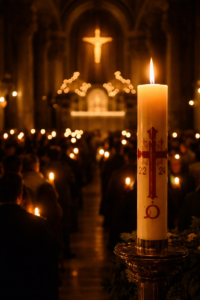
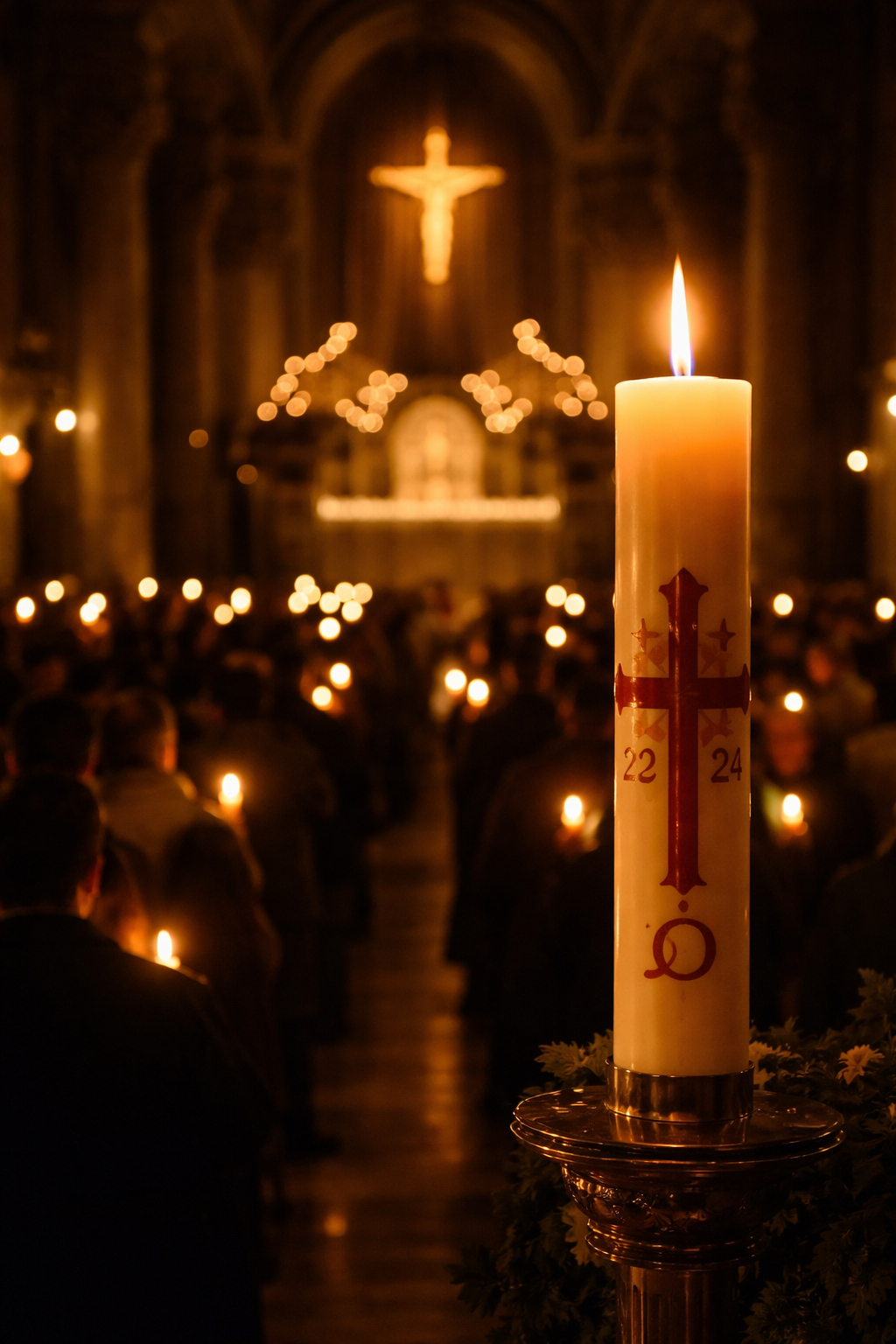
The claim usually traces back to the Easter Vigil, the most important liturgy in the Catholic Church. If you’ve ever attended one, you know it begins in darkness. A single flame is lit, then passed from candle to candle until the entire Church is gradually filled with light.
This isn’t just symbolism for its own sake. It’s meant to communicate something real: the movement from death to life, from darkness to light, from despair to hope.
During that liturgy, the Church proclaims an ancient hymn known as the Exsultet. Christians have been singing it for centuries. And within that hymn appears a word that, to modern ears, sounds jarring:
Lucifer.
Did Pope Francis Praise Lucifer? What Actually Happened
Today, the word “Lucifer” is almost universally associated with Satan. So when someone hears it used in a liturgical context, the reaction is immediate and understandable. Why would that word appear at all?
From there, the conclusion forms quickly: if the word is present, then it must be referring to the devil, and if it’s spoken within the liturgy, then somehow it is being affirmed.
But that conclusion depends on a hidden assumption—that the word has always carried the meaning we assign to it today. Historically, that simply isn’t the case.
 What “Lucifer” Actually Means
The word Lucifer comes from Latin and, in its original sense, is not a proper name at all. It means “light-bearer” or “morning star.” Long before it became associated with Satan, it was used more broadly to describe anything that brings light.
In early Christian usage, the term was even applied to Christ Himself, precisely because He is the one who brings light into darkness and rises like the morning star. When the Church uses the word during the Easter Vigil, it draws on that older, richer meaning.
In other words, the reference is not to Satan, but to Christ—the one who overcomes darkness, not the one who represents it.
So Why the Confusion?
The confusion comes from reading an ancient text with modern assumptions. Words change over time, sometimes dramatically, and when we ignore that shift, misunderstandings are almost inevitable.
A single word, removed from its historical context and presented in isolation, can easily be misread. Add the speed of social media, and that misreading spreads quickly, often without anyone stopping to ask whether the interpretation itself is sound.
The Deeper Issue
At this point, the question is no longer just about one word in one hymn. It becomes something more fundamental. Who determines what a text means?
When someone claims that “the Pope praised Lucifer,” they are not just making an observation—they are offering an interpretation. And like every interpretation, it rests on an authority, whether acknowledged or not.
This is where the conversation shifts from a misunderstanding to a principle:
👉 Who has the authority to interpret?
Why This Matters
This pattern shows up again and again. Different claims, same underlying issue:
-
Catholics worship Mary
-
The Church added to Scripture
-
The Pope invents doctrine
Each of these statements depends on a particular reading of events or texts. But without a stable authority to guide interpretation, those readings multiply—and often conflict.
Sincerity isn’t the problem. People can be sincere and still be mistaken. The real question is whether there is any reliable way to distinguish between the two.
The Bottom Line
No Pope has ever praised Lucifer. The claim rests on a misunderstanding of language, a loss of historical context, and, more deeply, a confusion about who has the authority to interpret what the Church teaches.
Once those pieces are put back in place, the claim loses its force.
A Better Question
Instead of reacting to isolated claims, it’s worth asking a more foundational question:
👉 Says who?
Who has the authority to interpret Scripture? Who preserves the meaning of what has been handed down? Who decides what is actually being taught?
That question doesn’t just resolve this issue. It clarifies nearly all of them.
Dig Deeper
Most objections to Catholicism feel complicated at first. But more often than not, they trace back to this single issue of authority.
If you want a clear, straightforward way to understand it, that’s exactly what I explore in Catholics Are Wrong? Says Who?—without jargon, and without assuming a theological background.