
A Catholic Moral Distinction About People, Politics, and Human Dignity
The question of anti-Zionism vs antisemitism has become one of the most debated moral and political issues today. Public discussion often treats opposition to Zionism and hostility toward Jews as if they were identical. For Catholics, this creates confusion. We must defend human dignity and reason carefully about political questions.
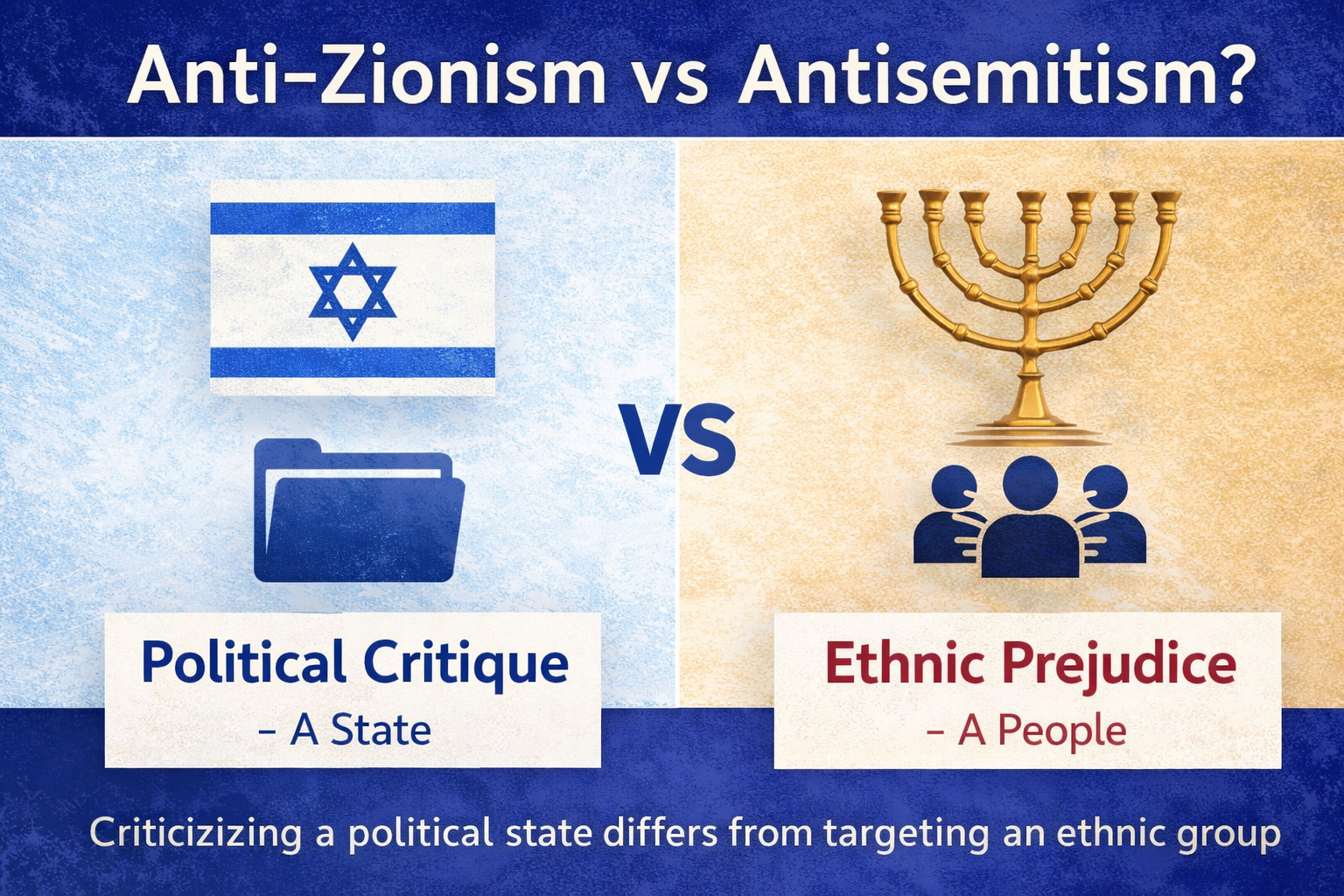
Public debate often treats two ideas as identical: opposition to Zionism and hostility toward Jews. For Catholics, this creates confusion. We must defend human dignity and reason carefully about political questions. The Church calls us to reject prejudice absolutely, yet it also permits legitimate moral evaluation of political arrangements. To understand the issue clearly, we must distinguish between a people and a political project.
 Anti-Zionism vs Antisemitism: The Church’s Teaching
The Catholic Church has repeatedly condemned antisemitism. Jews are not merely a social group or voting bloc; they are a people uniquely tied to salvation history. Christianity emerges from Israel — from the covenants, the prophets, and Christ according to the flesh. Because every human person bears the image of God (imago Dei), hatred directed toward Jews as Jews is a grave moral evil.
This point is not optional or political — it is theological.
A Catholic cannot despise Jews and remain faithful to Catholic moral teaching.
Therefore, violence against Jews, collective blame, conspiracy theories about Jewish control, or denying Jews equal dignity among nations are morally indefensible. When criticism targets Jewish identity itself, it is antisemitism.
A Brief Historical Background of Zionism
Modern Zionism emerged in late-19th-century Europe, primarily through the writings of Theodor Herzl and other Jewish intellectuals responding to persistent persecution and exclusion within European societies. It was not originally a purely religious movement but a nationalist one, shaped by the same currents that produced Italian, German, and Balkan nationalisms. Many early Zionists were secular and envisioned a political refuge where Jews could live safely as a people among the nations.
The movement gained urgency after repeated pogroms and ultimately the Holocaust, which profoundly influenced international support for a Jewish homeland and contributed to the establishment of the State of Israel in 1948. Thus, Zionism developed less as a doctrinal claim of Judaism and more as a modern political solution to a historical problem: the recurring vulnerability of Jews living as minorities in various states. This history shows why Zionism belongs to political history, not theological necessity. Understanding anti-Zionism vs. antisemitism requires recognizing this historical distinction between a people and a political movement.
Anti-Zionism vs Antisemitism in Political Philosophy
Zionism, therefore, is not identical to Judaism. It is a political claim: that the Jewish people ought to possess and maintain a sovereign nation-state in a specific territory. That question belongs to the realm of political philosophy and prudential judgment, not dogma.
Catholic social teaching does not teach that any religious group must possess a territorial state to practice its faith or preserve its identity. The Church herself exists in every nation without requiring political sovereignty. Protestants, Orthodox Christians, Muslims, Hindus, and Buddhists likewise live their religious lives without possessing a universal state defined by their religion. A people’s dignity does not depend on possessing borders.
Because of this, evaluating a state — its legitimacy, policies, borders, or founding ideology — is morally different from evaluating the worth of the people associated with it. We can morally analyze political entities. We never judge human dignity that way.
The Influence of Protestant Soteriology on Modern Perceptions
Many evangelical Christians support the modern State of Israel for theological reasons rooted in dispensationalism, a nineteenth-century interpretive framework popularized by John Nelson Darby and later the Scofield Reference Bible. Within this view, the biblical promises to Israel remain territorially and nationally binding in salvation history. A restored national Israel therefore becomes an expected stage preceding Christ’s return, and political developments involving Israel can take on theological significance.
Because of this framework, some Christians understand the existence and preservation of a Jewish state as part of the unfolding plan of redemption. Support for Israel is not merely political but religiously motivated, since prophecy is read as requiring a national restoration prior to the culmination of history.
Catholic theology approaches salvation history differently. The Church teaches that the promises to Israel find their fulfillment in Christ and extend universally through the people of God rather than through a particular political state. Catholics may prudentially support or oppose political arrangements in the Middle East for moral or humanitarian reasons, but they are not doctrinally bound to affirm any modern nation-state as necessary for the redemption of history. For that reason, some traditions treat disagreement over Zionism as doctrinal, while Catholic reasoning treats it as political.
Anti-Zionism vs Antisemitism: Criticism vs Prejudice
Catholic moral reasoning consistently distinguishes between persons and institutions. Catholics themselves regularly insist on this principle: one may criticize actions of the Catholic Church without hating Catholics. Likewise, one may question the justice or prudence of a government without denying the humanity of its citizens.
The same logic applies here. A person may support, oppose, or partially agree with Zionism for historical, legal, or ethical reasons. Such disagreement, by itself, does not constitute antisemitism. The decisive question is simple: what is being criticized? If the target is a government, borders, military actions, or political theory, it is political discourse.
-
If the target is Jews as Jews, it is prejudice.
The difference is moral, not semantic.
When Anti-Zionism Becomes Antisemitism
The boundary becomes clear when political language turns into collective accusation. Anti-Zionism becomes antisemitic when it denies Jews equal dignity, excuses violence against them, treats Jews worldwide as morally responsible for a government’s actions, or rejects their right to live in safety among nations.
At that point, the argument is no longer about a state. It is about people — and therefore morally wrong.
Anti-Zionism vs. Antisemitism: A Catholic Approach
Catholic thought resists two extremes:
-
claiming any criticism of Israel is antisemitic
-
disguising hostility toward Jews as political analysis
Catholic teaching distinguishes sharply between the Jewish people and modern political arrangements. The Second Vatican Council affirmed that Jews remain beloved by God and rejected all forms of antisemitism (Nostra Aetate 4). The Catechism likewise teaches that God’s covenant with the Jewish people has never been revoked (CCC 839–840). At the same time, the Vatican clarifies that the modern State of Israel is not interpreted as a direct theological fulfillment of biblical prophecy (The Gifts and the Calling of God Are Irrevocable §23).
For this reason, Catholic theology does not require adherence to any political position regarding Zionism while still demanding respect and protection for Jewish persons everywhere. The Catholic moral tradition instead insists on two principles held together:
-
Every Jewish person possesses inviolable dignity and must never be hated or threatened
-
We should morally evaluate political arrangements according to justice and the common good
Keeping these together protects both charity and reason. We defend persons absolutely while debating politics rationally.
Conclusion
From a Catholic perspective, antisemitism is always immoral. Political disagreement over Zionism falls within the scope of prudential judgment. What matters is not criticizing Israel, but targeting Jews themselves. Properly distinguishing anti-Zionism vs. antisemitism protects both truth and charity.
The Gospel commands Christians to love both truth and neighbor. When we carefully distinguish people from political systems, we honor both.