 Without teaching, we are confused, which is why authority is necessary. The question is not whether Christians should read Scripture; the question is who has the authority to settle Scripture's meaning when sincere Christians disagree.
The necessity of authority in teaching is fundamental to maintaining unity and avoiding confusion in matters of doctrine and faith. Without a recognized authority, individuals are left to their subjective interpretations, which inevitably lead to contradictions and divergent teachings. This is why the Bible-alone approach eventually runs into a practical problem: one pastor quotes Scripture and says it means one thing, while another pastor quotes the same Scripture and says it means something else. At that point, the real question becomes: Who decides which interpretation is authoritative? This is also why, logically, there must be an ultimate arbiter—whether it’s an individual or an institution—capable of definitively settling matters of doctrine. Without such authority, the result is a proliferation of conflicting beliefs, making it impossible to discern truth from error. Biblically, this role of authoritative teaching is evident in the way Christ entrusted His Apostles with guiding the Church, with Peter designated as the primary leader. Christ did not leave His followers with a book detached from a teaching Church. He gave authority to living men who could teach, correct, bind, loose, and preserve the faith once delivered.
The Teaching Authority of The Church
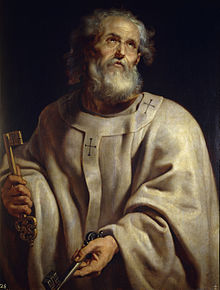
In Matthew 16:18, Jesus establishes Peter as the foundation of His Church: "You are Peter, and on this rock, I will build my Church, and the gates of hell will not prevail against it." This signifies a clear, divinely appointed authority vested in Peter and, by extension, the Apostles. Peter himself emphasized the importance of this authoritative teaching in 2 Peter 1:20–21, stating that no scripture is subject to personal interpretation, since prophecy comes from the Holy Spirit rather than human impulse. He also warned of the dangers of unauthorized teachings, as false teachers would introduce heresies that could lead to destruction (2 Pet. 2:1). Peter’s warning is especially important today because much of modern Christianity assumes the very thing Peter cautioned against: that Scripture can be finally settled by private interpretation. But if every individual believer, pastor, or denomination becomes its own final authority, unity becomes impossible.
This matters because authority is not the same as personal opinion. A pastor may be sincere, educated, and devoted to Scripture, but sincerity alone does not create authority. When pastors disagree, the question is not simply who has the better Bible verse, but who has been entrusted by Christ with the authority to teach in His name.
Paul, too, reinforced the need for obedience to Apostolic tradition, urging believers to "stand firm and hold to the traditions" taught by the Apostles (2 Thess. 2:15) and to avoid those who reject this authority (2 Thess. 3:14–15). This scriptural foundation underscores the necessity of divinely established authority to preserve unity and truth in the Church. Notice that Paul does not tell Christians to hold only to what has been written. He tells them to hold fast to what was taught, whether by word of mouth or by letter. Apostolic teaching was never reduced to Scripture alone.
The Church Sees What Christ Sees
The Church, through its teachings and traditions, sees the world as Christ sees the world, offering a divine lens through which human life, morality, and purpose are understood. This is grounded in the belief that the Church, as the Body of Christ, carries forward the mission and vision that Christ imparted to His Apostles. Without an authoritative body, however, this unified vision would quickly fracture. Individual interpretations of Christ's teachings would inevitably vary, leading to conflicting views on essential truths such as the nature of salvation, morality, and the sacraments. That is not merely a theoretical concern. It is exactly what we see when thousands of Christian communities appeal to the same Bible while disagreeing on baptism, communion, salvation, divorce, church government, morality, and the meaning of the Church itself.
This is why Catholic authority is not meant to replace Christ, but to preserve His teaching. The Church does not invent truth; she guards what she has received.
Why Authority
An authoritative body, such as the Magisterium (the teaching authority of the Church), is essential to safeguard and preserve the truth revealed by Christ. It ensures that the Church’s understanding of the world remains consistent with Christ’s teachings and is not diluted by personal biases or cultural trends. Without this centralized authority, the unity of belief that Christ prayed for in John 17—"that they may be one, as we are one"—would be lost, leaving believers to their own subjective interpretations and leading to doctrinal confusion and division. Just as Christ entrusted His Apostles with authority to teach and guide, the Church continues to rely on this authority to provide clarity, direction, and a shared vision rooted in divine truth.
Before asking whether Catholics are wrong, we have to ask a more fundamental question:
Says who?
Says your pastor? Another pastor? A Bible teacher? A denomination? A YouTube apologist?
If two Christians quote the same Bible and reach opposite conclusions, who has the authority to determine which interpretation is true? That is the question at the heart of Catholicism, and it is the question explored more fully in Catholics Are Wrong... Says Who?

You must be logged in to post a comment.