
The problem with the idea of the great apostasy is that it makes Christ a liar. The other day, I heard a knock at the door. When I opened it, two young Mormon missionaries were standing on the porch.
This was not the first time missionaries from the Church of Jesus Christ of Latter-day Saints had visited my home. In fact, I believe this was the third group that had stopped by over the years. One of the young men mentioned that other elders had spoken with me before and then asked what I had been thinking about since their last visit.
That question told me that they probably had some record of the previous conversations, which did not bother me. I appreciated the fact that they had returned. They were courteous, sincere, and clearly believed they had something important to share.
I also knew exactly where I wanted to begin. I told him;
“I still do not have an answer to the Great Apostasy you claim happened,”
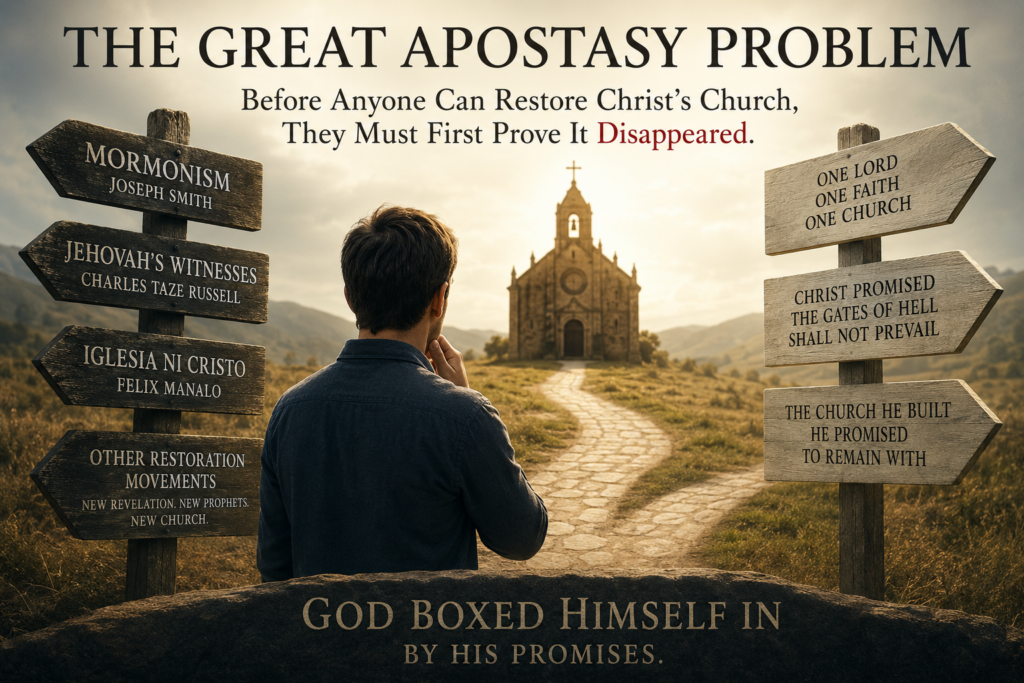
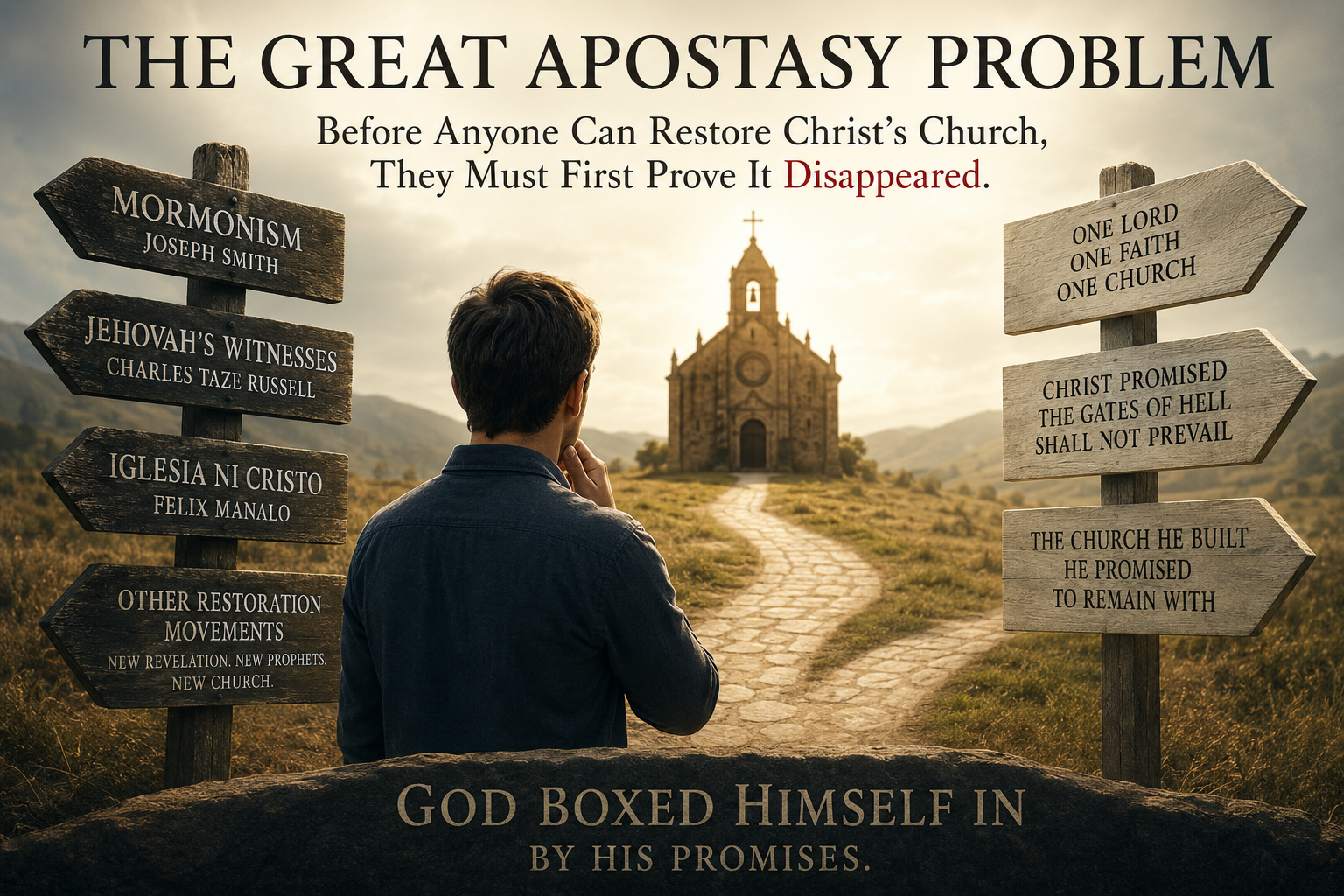
That question had remained unresolved after the earlier visits. Mormonism teaches that after the deaths of the apostles, the Church established by Jesus Christ experienced the great apostasy. It gradually fell away. Apostolic authority was lost, essential truths became corrupted, and the true Church eventually disappeared from the earth. According to the Mormon account, God later restored that Church through Joseph Smith in the nineteenth century. But before we can discuss whether Joseph Smith restored the Church, we first have to establish that Christ’s Church disappeared.
That is not a small historical detail. It is the premise upon which the entire restoration story depends. If the Church founded by Christ remained on earth, then there was no need for Joseph Smith to restore it.
This problem is not limited to Mormonism. The great apostasy is believed by Jehovah’s Witnesses, Iglesia ni Cristo, and a variety of independent restorationist movements, which make similar claims. The details differ from group to group, but the basic pattern remains the same. Christ established the true faith, the original Church became corrupted or disappeared, and then centuries later a particular founder, prophet, or organization recovered what had been lost.
Every restoration movement therefore faces the same problem. Before anyone can claim to have restored Christ’s Church, that person must first demonstrate that Christ’s Church actually ceased to exist.
 When was The Great Apostasy?
I asked the missionary when he believed the Great Apostasy had occurred. He was not sure but seemed to think it may have happened when the early Church councils began. He mentioned the Council of Nicaea and appeared to view it as some type of political gathering that changed Christianity.
I explained that the Council of Nicaea was not simply a meeting of politicians who sat down and invented Christian doctrine. It was a gathering of bishops who came together in A.D. 325 to address a serious controversy over the identity of Jesus Christ. Arius and his followers denied the full divinity of Christ, and the bishops met to defend what the Church had already received and believed. Most interesting about this council is that both sides used a lot of Scripture to make their argument. What we see is the Church exercising its authority.
The emperor Constantine called the bishops together, and political interests were certainly present, but Constantine did not invent the doctrine that Jesus is divine. The debate had already been taking place within the Church.
More importantly, councils did not begin with Constantine.
The first major Church council appears in the Bible itself. In Acts 15, the apostles and elders gathered in Jerusalem to resolve a dispute over whether Gentile converts were required to follow the Mosaic law. They discussed the issue, reached a judgment, and sent an authoritative decision to the churches.
Their letter did not say, “Each believer should read the Scriptures and decide for himself.” It said, “It has seemed good to the Holy Spirit and to us.”
That is the biblical model of a Church council. The leaders of the Church gathered, deliberated, and issued a decision for the Christian community.
The missionary did not seem to have considered the Council of Jerusalem in this way.
The previous Mormon missionaries who had visited me offered a different theory. They thought the Great Apostasy may have occurred shortly after the deaths of the apostles. Yet they had not been able to identify exactly when it happened either.
One group thought it happened soon after the apostles died. Another missionary suspected it may have happened when the councils began. No one could point to a specific event, date, doctrine, or historical rupture.
That seemed strange to me.
If Christ’s Church completely lost its authority and disappeared from the earth, I would expect the evidence to be far more compelling. I would expect restorationists to be able to identify the last legitimate bishop, the generation in which apostolic authority vanished, the teaching that caused the entire Church to become false, or the historical moment when every valid line of succession came to an end.
Where are the Christians living at the time who recognized that Christ’s Church had disappeared? Who announced that the Church no longer possessed the authority given by Christ? What happened that was so dramatic and universal that the entire Christian world lost the Church at once?
The claim is not merely that Christians sinned or that some bishops became corrupt. Catholics already know that happened. It is not simply that political leaders interfered with the Church or that doctrinal controversies arose. Those things are part of Christian history.
Jesus never promised that every bishop would be holy, every Christian would be faithful, or every century would be free from scandal. The presence of sin within the Church does not prove the disappearance of the Church.
The Mormon claim is much greater than that. It requires us to believe that the Church established by Jesus Christ lost the authority Christ had given it and then remained absent from the earth for approximately eighteen centuries.
A claim that large requires more than a vague theory about Constantine or a hunch about Nicaea. It requires clear and demonstrative evidence.
The missionary did not have it.
“God Is Not Boxed In”
As the conversation continued, he explained that revelation did not end with the apostles. God could continue revealing new scripture, appoint new prophets, and speak through others as he did with Joseph Smith.
Then he said, “God is not boxed in.”
I understood what he meant. He believed I was placing an artificial limitation on God by saying that public revelation had been completed in Christ and entrusted to the apostles. Since God can do anything, he reasoned, God could reveal another book, choose another prophet, and restore the Church in the nineteenth century. So I responded,
“God boxed Himself in.”
He looked shocked. He almost gasped. He could not believe what I just said.
The phrase was intentionally provocative. I was using his own words to interrupt the usual way of thinking about the subject. I was not suggesting that some outside power had placed a restriction upon God. I was saying that God freely bound Himself through His own promises. God does not lie. God does not contradict Himself. God does not make a covenant, give His word, and then quietly abandon it.
When God promises something, He remains faithful to that promise. Faithfulness is not a weakness or limitation. It is a perfection. That is what I meant when I said that God boxed Himself in.
Christ Promised to Remain With His Church
Jesus did not simply gather a loose collection of believers and leave everyone to follow private inspiration. He established a Church, gave authority to the apostles, and promised to remain with them. He told Peter,
“You are Peter, and on this rock I will build my church, and the gates of Hades shall not prevail against it.”
Before ascending into heaven, He told the apostles, “I am with you always, to the close of the age.”
He also promised that the Holy Spirit would remain with them forever.
These were not temporary promises. Jesus did not say that He would remain with His Church only until the last apostle died. He did not promise that the Holy Spirit would guide Christians for a few generations and then disappear. He did not say that the gates of hell would fail to prevail until the Church began holding councils. He promised to remain with His Church until the end.
The Great Apostasy claim therefore raises a much larger question than whether some Christians departed from the faith. If the entire Church lost its authority, abandoned the truth, and disappeared from the earth, what happened to Christ’s promises?
Either Christ preserved the Church He established, or He did not. If He did, then the great apostasy is a great fantasy to justify other religions.
The Apostles Prepared for Continuity
The New Testament does not present the apostles as men who expected their authority to vanish with their deaths. They appointed other men, laid hands on them, and instructed them to appoint still others.
When Judas died, the apostles selected Matthias to take his office. Paul and Barnabas appointed presbyters in the churches they established. Paul reminded Timothy of the gift he had received through the laying on of hands and instructed Titus to appoint presbyters in every town.
Paul also told Timothy to entrust what he had received to faithful men who could teach others.
That passage contains several generations of transmission: Paul teaches Timothy, Timothy entrusts the teaching to faithful men, and those men teach others.
This does not sound like a Church preparing to disappear. It sounds like a Church deliberately preserving and transmitting apostolic teaching and authority from one generation to the next.
The early Christians understood that the faith received from the apostles was to be guarded and handed on. The authority of the Church did not depend upon the apostles remaining physically alive forever. It continued through the men they appointed.
What Prevents Anyone From Making the Same Claim?
The missionary believed that Joseph Smith was a prophet because God had revealed new truth to him.
So I asked what I thought was a simple but necessary question.
“What prevents anyone from making the same claim?”
Joseph Smith said God spoke to him. Muhammad claimed to receive revelation. Ellen White (Seventh-day Adventist Church) reported prophetic visions. Throughout history, many religious founders, teachers, and independent preachers have claimed that God gave them a special message. Some said the original Church failed. Others claimed the Bible was corrupted. Others taught that God had chosen them to restore the truth. The problem is that these revelations contradict one another. They cannot all be true.
How, then, do we determine who is genuinely speaking for God?
A person cannot establish that he is a prophet merely by announcing that God told him he was a prophet. The claim cannot prove itself. To say that Joseph Smith is a prophet because Joseph Smith said God revealed to him that he was a prophet is circular reasoning.
The Mormon response often involves praying about the Book of Mormon and seeking an internal spiritual confirmation. Yet sincere people in many religions report powerful spiritual experiences. A person can be sincere and still be mistaken.
Feelings may be meaningful, but they cannot serve as the final authority when competing prophets claim contradictory revelations.
If every person must rely primarily upon an internal feeling, then all of us are left blowing in the wind. One person follows Joseph Smith. Another follows Muhammad. Another follows an independent preacher who claims that God speaks directly through him.
Thankfully, God did not leave Christianity that way.
He established a visible Church. He gave it authority. He promised to remain with it.
That is another sense in which God boxed Himself in. He gave us something outside our private feelings by which competing claims could be tested.
The Great Apostasy, The Church & The Bible
The missionary also suggested that there may be many writings from God that are not found in the Bible. That claim immediately raises another question. How do we know which writings belong in Scripture?
The Bible did not descend from heaven with an inspired table of contents. Many Christian writings circulated during the early centuries. Some were inspired, some were useful but not inspired, and others were rejected.
The Church gradually discerned which writings had been received from the apostles and consistently used in Christian teaching and worship. The canon was recognized through the life and authority of the early Church, including councils at Rome, Hippo, and Carthage in the late fourth century.
The Church did not create Scripture. It identified which writings were inspired.
Restorationist movements often ask us to believe that the historic Church lost divine authority while simultaneously trusting that same Church to preserve and identify the New Testament.
That creates an obvious tension. If the early Church had already become completely apostate, why should anyone trust its judgment about the biblical canon? How can a false and abandoned Church reliably preserve the very Scriptures later used to condemn it?
It is difficult to accept the Bible preserved by the historic Church while claiming that the historic Church had lost the guidance of the Holy Spirit.
The Question The Great Apostasy Forgets
In the end, I returned to the question that had begun our conversation. Before I can believe that Joseph Smith restored Christ’s Church, someone must first show me when Christ lost it.
Not when Christians sinned. Not when bishops disagreed. Not when an emperor became involved. Not when councils gathered.
Someone must demonstrate when the authority established by Christ vanished from the earth. Someone must explain how that happened despite Christ’s promise that the gates of hell would not prevail against His Church. Someone must explain how the Holy Spirit ceased guiding the Church even though Jesus promised that He would remain with it forever.
The missionary did not have an answer.
I did not expect him to change his mind while standing at my door. People rarely abandon an entire worldview during a single conversation. Religious beliefs are tied to family, friendships, personal experiences, identity, and community. Sometimes a person must encounter a question and then live with it for a while before he can begin to reconsider what he has always believed.
I gave him a copy of Catholics Are Wrong, Says Who?
The book explores the same underlying questions that shaped our conversation. Who has the authority to determine what Christianity teaches? Where did that authority come from? How do we know which interpretation is correct? And by whose authority can someone living centuries after Christ declare that the Church established by Jesus disappeared and later had to be restored? He told me that he would read my book and return.
My purpose in giving him the book was not to overwhelm him with Catholic doctrine. It was to give him a way to examine the assumptions beneath the restoration story and the great apostasy at his own pace.
I really hope he will return. My goal was not to insult him, embarrass him, or win a quick argument. The goal was to leave him with one unavoidable question that the great apostasy hinges on.
If Jesus promised to preserve His Church, by whose authority do we declare that He failed?
That question applies not only to Mormonism, but to every movement that claims authentic Christianity vanished until its founder arrived. Iglesia ni Cristo makes a similar claim
Before anyone claims to have restored the Church, that person must first prove that Christ allowed His Church to disappear.
God is not controlled or limited by human beings. But God is faithful to His own word. He established a Church, gave it authority, sent the Holy Spirit to remain with it, and promised to be with it until the end.
In that sense, God boxed Himself in. And thankfully, He did. Because without His promises, His Church, and the authority He established, we would all be left at the mercy of the next person who knocks on the door and says, “God revealed something new to me.”
For readers who have been told that the Catholic Church fell away from the faith established by Christ, Catholics Are Wrong Says Who? takes up the deeper question beneath those accusations: Who has the authority to decide what authentic Christianity is?
You must be logged in to post a comment.