
If we truly trust Jesus, shouldn’t we also trust the Church He established?
“Just trust in Christ alone.”
It’s a beautiful expression we hear often from Evangelical Christians, especially when discussing salvation. And who could disagree? Of course we should trust Christ. He is our Savior, our Redeemer, the way, the truth, and the life. But as I’ve heard Christians use this expression over the years, I’ve often wondered whether we’ve given it enough thought.
What does it mean to trust Jesus? Is it enough to believe He died for our sins and accept Him as our personal Savior? Does trust involve obedience, following His teachings, and accepting what He asks of us, even when we don’t fully understand or agree?
I suspect most Christians would acknowledge that genuine trust involves more than simply believing certain things about Jesus. After all, as St. James reminds us, even the demons believe in God (James 2:19). The difference is that genuine faith calls us into a relationship with Christ, one that necessarily involves following Him.
And that’s where I think the familiar expression trust in Christ alone raises an interesting question. If we are going to trust Christ, shouldn’t we also trust the means He established for us to follow Him?
Jesus Didn’t Just Say, Trust me alone or believe in me, He said Follow Me.
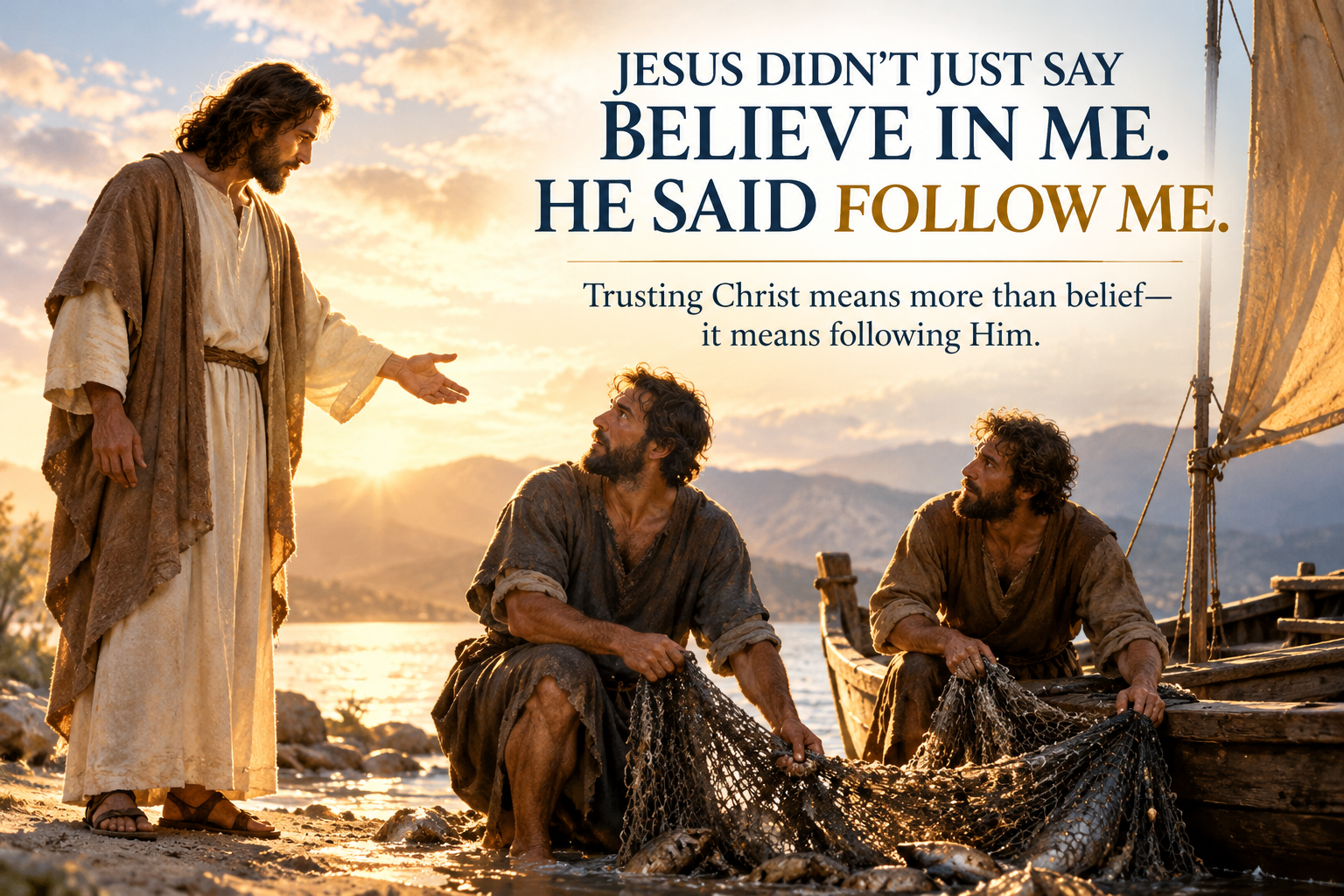 Throughout the Gospels, Jesus calls people to follow Him. Peter and Andrew leave their fishing nets, Matthew leaves his tax collector’s booth, and ordinary people abandon their former lives to become His disciples. Jesus doesn’t simply ask them to believe certain things about Him. He invites them to entrust their lives to Him, and that trust carries expectations.
“If you love me, you will keep my commandments,” He tells His disciples (John 14:15). Elsewhere, He asks, “Why do you call me ‘Lord, Lord,’ and not do what I tell you?” (Luke 6:46).
It’s a rather uncomfortable question, especially for anyone who believes that professing faith in Jesus is sufficient without considering what He actually commands.
Consider what trust means in an ordinary relationship. If I tell my physician I trust him but routinely disregard his advice, reject his treatment, and substitute my own medical opinions, how much am I really trusting him? I might admire his intelligence and believe he’s an excellent physician, but my actions suggest that when it comes to deciding what is best, I ultimately trust myself.
Something similar can happen in our relationship with Christ. We can sincerely profess our trust in Him while reserving the right to decide for ourselves which of His teachings we’re willing to accept. And this becomes particularly important when we consider something Jesus did that is frequently overlooked in discussions about faith.
He established a Church.
Jesus didn’t simply travel around Judea preaching inspiring sermons and encouraging people to develop a personal relationship with God. He chose twelve apostles, prepared them for their mission, gave them authority, and commissioned them to teach and baptize in His name.
Before His Ascension, He instructed them to make disciples of all nations, baptizing them and teaching them to observe everything He had commanded (Matthew 28:19–20). Notice that He didn’t tell them to write a book and leave future generations to figure out Christianity independently. He established a teaching Church and promised to remain with His disciples until the end of the age.
This doesn’t diminish the importance of Scripture. Catholics recognize the Bible as the inspired Word of God. But the Bible itself reveals that Christ established something more than a collection of sacred writings. He established a visible community of believers under the leadership of His apostles, entrusted them with His teachings, and promised that the gates of hell would not prevail against His Church (Matthew 16:18).
That promise ought to mean something to anyone who claims to trust Christ.
The Church Is Not a Substitute for Christ
One of the most revealing passages in the New Testament appears in St. Paul’s first letter to Timothy, where he describes the Church as “the church of the living God, the pillar and bulwark of the truth” (1 Timothy 3:15).
That’s an extraordinary description. Paul doesn’t present the Church as an optional gathering place for Christians who have already determined for themselves what Christianity means. He describes her as the pillar and foundation supporting the truth, entrusted with preserving and faithfully transmitting what Christ revealed.
From the Catholic perspective, this is precisely why the Church possesses authority. Not because priests and bishops are always wise or holy, and certainly not because they are incapable of making mistakes. Church history provides more than enough evidence of human weakness, corruption, and scandal. Our confidence in the Church’s teaching authority doesn’t rest upon the personal virtue of her leaders, but upon the promises of Jesus Christ.
When Jesus tells His apostles, “He who hears you hears me, and he who rejects you rejects me” (Luke 10:16), He is doing something remarkable. He is authorizing imperfect human beings to speak in His name. The Catholic understanding is that this apostolic teaching authority continues in the Church Christ established.
This also helps explain why the familiar expression “I trust Jesus, not religion” is more complicated than it sounds. I understand the sentiment, especially among people who have been disappointed or wounded by religious institutions. But if Jesus Himself established a Church, entrusted her with His teachings, and gave her authority to guide His followers, then rejecting that authority in the name of trusting Jesus presents a contradiction worth examining.
Of course, we must establish whether the Catholic Church really is the Church Christ founded. That’s a legitimate historical and theological question, one I’ve explored elsewhere in When Did the Catholic Church Begin?. But if that claim is true, then trusting the Church’s divinely established authority isn’t a departure from trusting Christ. It’s an expression of that trust.
Are We Trusting Christ Alone or Our Interpretation of Christ?
Here’s where I think the conversation becomes particularly interesting.
Ask a group of Christians what it means to trust Jesus and you’ll hear considerable agreement. They’ll speak about faith, forgiveness, repentance, obedience, and surrendering their lives to God. But begin asking more specific questions about what Jesus taught, and those agreements often disappear.
Is baptism necessary for salvation, or merely an outward symbol of something that has already happened? When Jesus said we must eat His flesh and drink His blood, was He speaking literally or symbolically? Did Christ give His apostles authority to forgive sins? Can salvation be lost?
These aren’t trivial matters. They concern the very means by which Christians understand salvation, receive God’s grace, and live their faith. Yet sincere Christians, often reading the very same Scriptures, reach radically different conclusions.
Someone will inevitably respond, “We simply need to go back to the Bible.” And I agree that we should turn to Scripture. But that response doesn’t actually resolve the disagreement, because both individuals are already reading the Bible. Their disagreement isn’t necessarily about whether Scripture is true. It’s about what Scripture means.
We can study the original languages, examine historical context, consult biblical scholars, and read the early Church Fathers. These are valuable ways to deepen our understanding. But eventually someone must decide which interpretation is correct and whether that interpretation is binding upon other Christians.
If every individual Christian possesses the final authority to decide what Scripture means, then we haven’t really eliminated human authority. We’ve simply relocated it from the Church to ourselves.
And therein lies the irony. Someone may sincerely insist, “I don’t trust the authority of the Church. I trust Christ alone.” But if he determines what Christ teaches exclusively through his own interpretation of Scripture, how does he know that he is trusting Christ rather than his own understanding of Christ?
I’m not questioning anyone’s sincerity. I believe most Christians genuinely want to follow Jesus faithfully. But sincerity alone doesn’t settle competing interpretations, and the Bible doesn’t interpret itself.
That’s why the question of who has the authority to interpret Scripture is so important. It isn’t simply another theological disagreement among many. It underlies virtually every disagreement Christians have about what Christ taught.
And it raises a question that the doctrine of the Bible alone must ultimately address: Where did Christ place the authority to teach His followers?
Trusting Christ With the Humility of a Child
One of the things I find most reassuring about the Catholic faith is that Jesus didn’t make salvation dependent upon our ability to become biblical scholars.
For most of Christian history, ordinary believers couldn’t read, books were expensive, and personal copies of Scripture weren’t readily available. Yet Christianity spread throughout the Roman Empire and beyond through the preaching, worship, and sacramental life of the Church.
Christians were baptized, instructed in the faith, gathered for the Eucharist, and learned to follow Jesus within the community He established. They didn’t need to master Greek or Hebrew or independently resolve every theological controversy. They needed to receive the faith entrusted to the Church and live it.
None of this means Christians should stop studying Scripture or asking difficult questions. Quite the opposite. Understanding our faith is an important part of growing in it. But there’s a difference between seeking to understand what Christ has revealed and assuming that each of us possesses the final authority to determine what Christianity means.
I often think about Jesus telling His followers that unless they become like little children, they will never enter the kingdom of heaven (Matthew 18:3).
Children aren’t known for their superior knowledge or intellectual sophistication. They depend upon others to guide and teach them. A child doesn’t need to understand everything before trusting someone worthy of that trust.
Perhaps there’s a lesson here for Christianity today. We’ve become so accustomed to thinking that each person must decide for himself what Christianity teaches that we sometimes overlook the humility involved in receiving a faith we did not invent.
The Catholic faith asks us to recognize that Christianity existed long before we arrived and that Christ provided a means by which His teachings could be faithfully preserved and handed down. We are free to investigate that claim, question it, and seek to understand it. But if we discover that Christ really did establish an authoritative Church, humility requires us to consider whether following Him includes accepting that authority.
After all, the Church isn’t supposed to stand between us and Christ as some competing source of salvation. Christ alone saves. The Church’s mission is to proclaim Him, communicate His grace through the sacraments, and guide His followers in the truth He revealed.
Her authority, properly understood, comes from Him and exists to serve Him.
So What Does It Really Mean to Trust Christ Alone?
Let’s return to where we started.
If trusting Christ alone means that Jesus is our only Savior, that salvation is a gift of God’s grace rather than something we can earn, and that we owe Him our complete faith and obedience, Catholics can say amen to all of that.
But if trusting Christ means rejecting the authority of the Church He established and relying upon our own interpretation of His teachings, I think we have to ask where Jesus told us to do that.
The Jesus we encounter in Scripture didn’t simply tell His followers to believe in Him and then figure out Christianity for themselves. He called them to follow Him, established His Church, entrusted His teachings to His apostles, and promised to remain with them until the end of the age.
I don’t need to believe that every priest is holy, every bishop is wise, or every decision made by Church leaders is perfect. I need to trust that Jesus Christ knew what He was doing when He established His Church and that He remains faithful to His promises.
Perhaps the real question isn’t whether we should trust Christ alone. Perhaps it’s whether we’re willing to trust Christ enough to follow Him on His terms rather than our own.
Because trusting Jesus and trusting our own interpretation of Jesus are not necessarily the same thing.
Catholics Are Wrong—Says Who?
 If you’ve ever been told that Catholics are wrong about salvation, baptism, confession, the Eucharist, or the authority of the Church, you’ve probably noticed how quickly these conversations become an exchange of Bible verses. Both sides quote Scripture, and both insist their interpretation is correct.
But there’s a question that often gets overlooked: Who has the authority to determine what Christianity actually teaches?
That’s the question at the heart of my book, Catholics Are Wrong—Says Who?
I wrote it for ordinary Catholics, not theologians or biblical scholars. You don’t have to memorize hundreds of Bible verses or become an expert in Church history to understand the foundations of your faith. Sometimes all it takes is a little common sense, a willingness to ask the right questions, and the childlike faith Jesus encouraged.
Before accepting that Catholics are wrong, perhaps we ought to ask: Says who?
Discover Catholics Are Wrong—Says Who?
Bill Moran | Founder, WhyCatholic.com
You must be logged in to post a comment.