The Eucharist: Is It Really the Body and Blood of Christ?
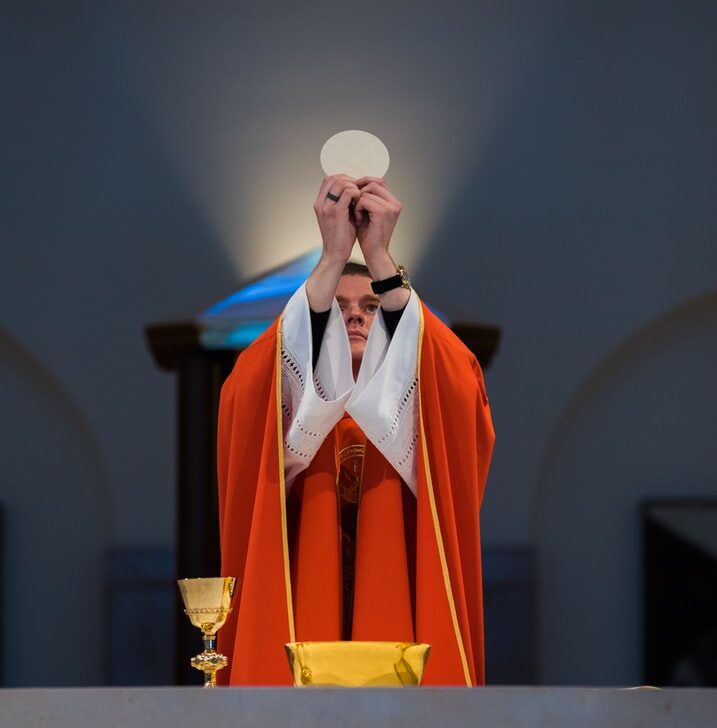
The Eucharist is one of the greatest dividing lines between Catholics and many Protestants. Catholics believe that when Jesus said, “This is my body” and “This is my blood,” He meant what He said. Christ is not merely remembered in the Eucharist or represented by bread and wine. Catholics believe He is truly present, Body, Blood, Soul and Divinity, under the appearances of bread and wine. This is what the Church means by the Real Presence.
Many Protestants sincerely disagree. They believe Communion is primarily symbolic, a memorial through which Christians remember Christ’s sacrifice on the Cross. Both Catholics and Protestants read the same Bible, so the question is not whether we can find a verse that supports what we already believe. The real question is much simpler: What did Jesus actually teach?
What Did Jesus Teach About the Eucharist?
The Eucharist was instituted at the Last Supper, but Jesus had prepared His disciples for this teaching much earlier. In John 6, after feeding the multitude, Jesus begins speaking of Himself as the Bread of Life. As the conversation continues, His words become increasingly difficult to dismiss as merely symbolic. He tells His listeners that the bread He will give is His flesh for the life of the world and that unless they eat the flesh of the Son of Man and drink His blood, they do not have life within them.
His listeners immediately recognize how extraordinary this sounds. They ask, “How can this man give us his flesh to eat?” This would have been the perfect opportunity for Jesus to correct them if they had misunderstood Him. He could have said that He was merely using bread as a metaphor for believing in Him. Instead, He continues the teaching and intensifies it, telling them that His flesh is true food and His blood is true drink.
The reaction is just as important as the words themselves. Many of His disciples respond, “This saying is hard; who can accept it?” Then John records something astonishing: “As a result of this, many of his disciples returned to their former way of life and no longer accompanied him” (John 6:66).
Jesus allows them to leave.
He does not run after them and explain that they misunderstood a symbol. He does not soften His language or assure them that nobody would actually be required to eat His flesh. Instead, He turns to the Twelve and asks whether they are going to leave too. Peter responds not by claiming that he completely understands the teaching, but by trusting the authority of the One who taught it: “Master, to whom shall we go? You have the words of eternal life.”
That exchange matters. The Eucharist was difficult when Christ first taught it. The fact that it remains difficult today is not evidence that Christians should reinterpret it into something easier.
“This Is My Body”
At the Last Supper, what Jesus had taught in John 6 becomes concrete. He takes bread, blesses it, breaks it and gives it to the apostles, saying, “This is my body.” He takes the cup and identifies it with His blood of the covenant.
Catholics do not believe that the Eucharist turns into ordinary human flesh that looks, tastes or feels like flesh. The appearances of bread and wine remain. The Church uses the term transubstantiation to describe the deeper reality: what appears to the senses as bread and wine has become, in substance, the Body and Blood of Christ.
This is why the accusation of cannibalism misses what Catholicism actually teaches. The Church is not claiming that Christ is present in the crude manner in which ordinary flesh occupies space. It is claiming that the risen Christ makes Himself sacramentally present in precisely the manner He chose.
And notice again that the Catholic Church did not invent the words upon which this belief rests. Catholics did not put the sentence “This is my body” into Scripture. Jesus did.
What Did Paul Believe About the Eucharist?
Saint Paul makes the idea of a merely symbolic Communion even more difficult to sustain. In 1 Corinthians 10, he asks whether the cup of blessing is not a participation in the blood of Christ and whether the bread is not a participation in the body of Christ. Then, in 1 Corinthians 11, his language becomes even stronger.
Paul warns Christians that whoever eats the bread or drinks the cup of the Lord unworthily will be “guilty of the body and blood of the Lord.” He tells believers to examine themselves and warns against receiving without discerning the body.
That raises an obvious question. If the Eucharist is simply bread and wine used to remind us of Jesus, why would receiving it improperly make someone guilty concerning the Body and Blood of Christ? We would not speak that way about mishandling a photograph of someone we love or treating another symbol disrespectfully. Paul’s warning makes sense if something far greater than a symbol is present.
What Did the Earliest Christians Believe?
The historical evidence is equally important because we do not have to wait centuries to discover what Christians believed about the Eucharist. We can look at Christians who lived immediately after the apostolic age.
Around A.D. 107, St. Ignatius of Antioch condemned those who abstained from the Eucharist because they refused to acknowledge it as the flesh of Jesus Christ. This is extraordinarily early Christian testimony. Ignatius did not live in medieval Europe. He belonged to the generation immediately following the apostles and was being taken to Rome to be martyred for his Christian faith.
A few decades later, around A.D. 150, St. Justin Martyr explained Christian worship to the Roman emperor. He specifically stated that Christians did not receive the Eucharist as ordinary bread and ordinary drink but as the flesh and blood of the incarnate Jesus Christ. Irenaeus would likewise speak of the Eucharistic bread and cup in connection with the Body and Blood of Christ later in the second century.
This creates a serious historical problem for the idea that the Catholic doctrine of the Real Presence was a later invention. If Jesus’ followers originally believed Communion was merely symbolic, the change must have happened extraordinarily early, spread throughout the Christian world, and apparently occurred without leaving behind evidence of a great controversy over the abandonment of the supposedly original belief.
A much simpler explanation is available: the earliest Christians believed what Catholics believe because that is what they had received from the apostles.
This is the same historical question we encounter when asking when the Catholic Church actually began. The further backward we follow these distinctly Catholic beliefs, the closer we get to the apostles rather than farther away from them.
But Didn’t Jesus Often Speak Symbolically?
Of course He did. Jesus called Himself a door and a vine. He used metaphors, parables, and figures of speech throughout His ministry. But simply observing that Jesus sometimes spoke symbolically does not prove that every difficult statement He made was symbolic. Context has to determine that.
When Jesus said He was a door, nobody asked how He could possibly be made of wood. When He spoke about eating His flesh, however, His listeners understood Him in a startlingly literal way. They objected to what He had said; Jesus continued rather than corrected them; some disciples declared the teaching intolerable, and then they left Him because of it.
A symbolic interpretation therefore has to explain not merely the words “eat my flesh” but the entire sequence of John 6. Why did Jesus allow disciples to abandon Him over a misunderstanding that He could have corrected with a single sentence?
Catholics believe the most natural answer is that they had not misunderstood the teaching. They understood enough to know that they could not accept it.
The Eucharist Is a Memorial, But Not Merely a Memorial
Catholics do not deny that the Eucharist is a memorial. The problem is with the word merely. It is a memorial, but it is more than a memorial. It uses signs, but it is more than a symbol.
At every Mass, Catholics believe the one sacrifice of Christ is made sacramentally present; Christ is not crucified again. The sacrifice of Calvary occurred once for all. Yet the same Christ who offered Himself on the Cross gives Himself sacramentally to His Church in the Eucharist.
That is why Catholic churches reserve the Eucharist in the tabernacle. It is why Catholics genuflect toward the tabernacle, why Eucharistic adoration exists, and why receiving Holy Communion is treated with such seriousness. These practices make little sense if the consecrated host remains ordinary bread serving merely as a reminder of an absent Christ.
Catholics act as though Jesus is really there because we believe Jesus is really there.
Why the Eucharist Matters
The Eucharist also tells us something profound about Christianity itself. Christianity is not simply agreeing with certain ideas about Jesus. Christ came to unite humanity to Himself. He entered our physical world, took on human flesh, suffered physically, died physically, and rose bodily from the dead. Catholic Christianity has therefore never treated matter as though it were irrelevant to our relationship with God.
God communicates grace through physical realities. Water is used in baptism. Oil is used in anointing. Hands are laid upon people. Marriage joins two bodies as well as two lives. In the Eucharist, bread and wine become the means through which Christ gives Himself to His people.
This is why the Church calls the Eucharist the source and summit of the Christian life. It is not an interesting Catholic devotion added to Christianity. If the Catholic understanding is true, the Eucharist is Christ Himself giving Himself to His Church.
Catholics and Protestants Read the Same Bible
This brings us to a problem much larger than the Eucharist. A Catholic reads John 6 and concludes that Jesus taught the Real Presence. A Protestant reads the same chapter and may conclude that Jesus was speaking symbolically. Catholics read “This is my body” and take those words substantially as they stand. Other Christians understand them to mean “This represents my body.”
Both sides quote Scripture. Both sides may be sincere. Both insist that the Bible supports their interpretation. So how do we settle the disagreement?
Quoting another Bible verse does not necessarily solve the problem because the disagreement itself is over what those verses mean. Eventually, we arrive at the question that lies underneath almost every Catholic-Protestant dispute: Who has the authority to determine what Christianity teaches?
Did Jesus leave Christianity dependent upon each believer reading Scripture and deciding what it means, or did He establish a visible Church with authority to preserve, interpret and teach the faith entrusted to the apostles?
That is why the Eucharist ultimately leads back to the question of authority in Christianity and why the doctrine of Bible Alone deserves careful examination. If sincere Christians can read the same inspired Bible and reach contradictory conclusions about something as fundamental as the Body and Blood of Christ, saying “the Bible is my authority” simply pushes the question back one step. Whose interpretation of the Bible?
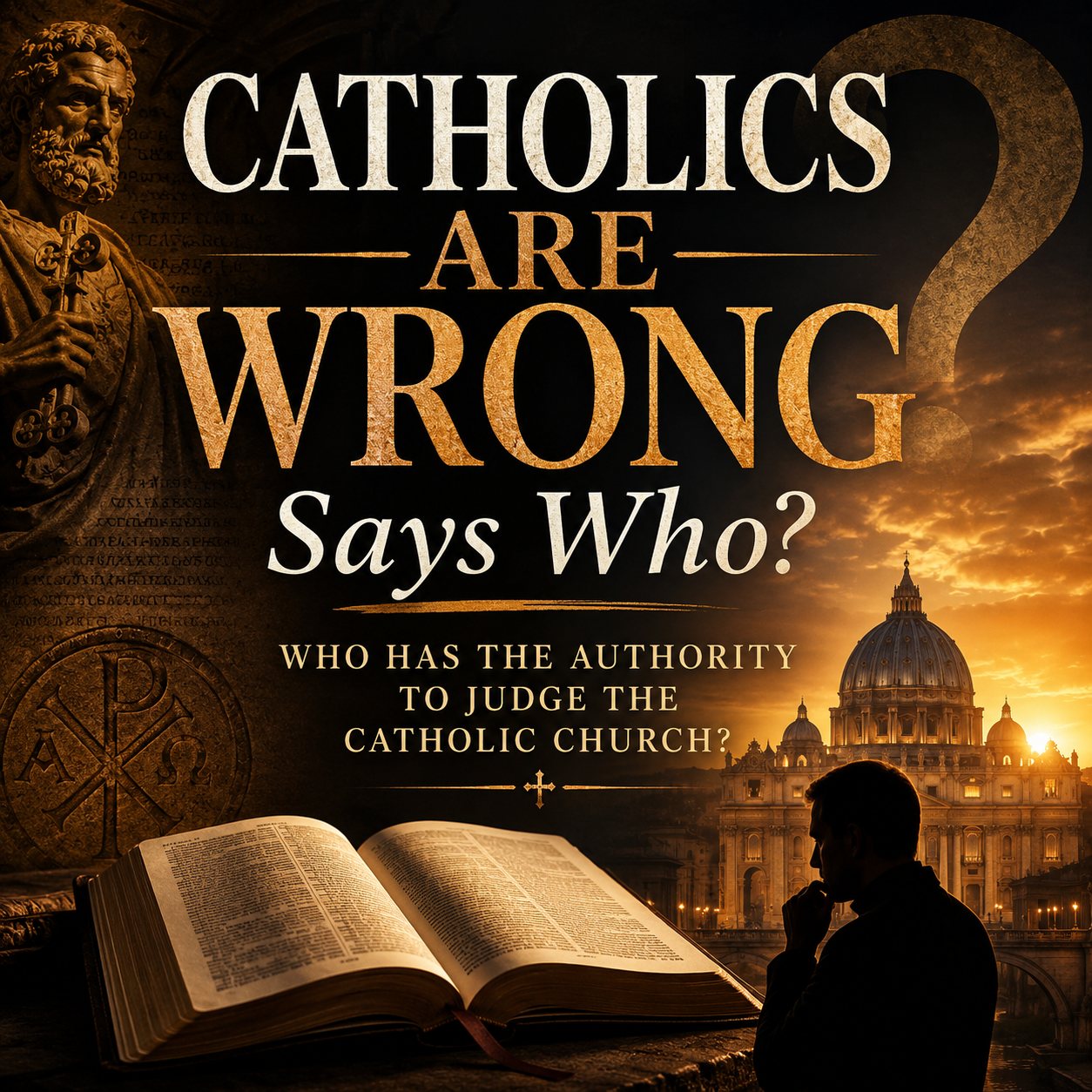
Catholics Are Wrong… Says Who?
The Eucharist is a perfect example of why I wrote Catholics Are Wrong… Says Who? We can spend endless hours debating John 6, baptism, confession, Mary, salvation, purgatory and dozens of other doctrines. But underneath almost every one of those arguments is the same unresolved question.
Who did Jesus Christ give the authority to teach His Church?
Once we answer that question, many of the disputes that appear hopelessly complicated become much easier to understand. Catholics Are Wrong… Says Who? does not ask you simply to accept that Catholics are right. It asks you to examine the authority upon which any Christian can say another Christian is wrong.
Get Catholics Are Wrong… Says Who? on Amazon

You must be logged in to post a comment.