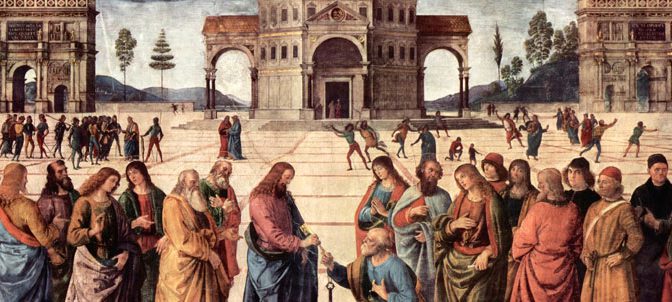
Jesus calls His apostles to follow Him, illustrating what it means to trust Christ and His Church.

Ano Ba Talaga ang Ibig Sabihin ng Magtiwala Kay Cristo Lamang?

Kung tunay tayong nagtitiwala kay Jesus, hindi ba dapat din nating pagkatiwalaan ang Simbahang Kanyang itinatag?

“Magtiwala ka lang kay Cristo.”

Magandang pakinggan, hindi ba? Simple, nakaaaliw, at tunay na Kristiyano. Madalas nating marinig ang mga salitang ito, lalo na mula sa ating mga kapatid na Evangelical Christian kapag pinag-uusapan ang kaligtasan at pananampalataya.

At sino naman ang hindi sasang-ayon? Siyempre, dapat tayong magtiwala kay Cristo. Siya ang ating Tagapagligtas, Manunubos, ang daan, ang katotohanan, at ang buhay.

Ngunit habang naririnig ko ang mga Kristiyanong gumagamit ng mga salitang ito, madalas kong naiisip kung talagang napag-isipan natin kung ano ang ibig sabihin ng pagtitiwala kay Cristo.

Sapat na bang maniwala na namatay Siya para sa ating mga kasalanan at tanggapin Siya bilang ating personal na Panginoon at Tagapagligtas? O kasama rin ba sa pagtitiwala ang pagsunod sa Kanyang mga utos at pagtanggap sa Kanyang mga aral, kahit may mga pagkakataong hindi natin lubos na nauunawaan o sinasang-ayunan ang mga ito?

Sa palagay ko, karamihan sa mga Kristiyano ay sasang-ayon na ang tunay na pagtitiwala ay higit pa sa paniniwala lamang sa ilang katotohanan tungkol kay Jesus. Kung tutuusin, ipinaaalala ni Santiago na maging ang mga demonyo ay naniniwalang may Diyos (Santiago 2:19).

Ang tunay na pananampalataya ay humihingi ng higit pa rito. Tinatawag tayo nito sa isang buhay na pakikipag-ugnayan kay Cristo, isang ugnayang nangangailangan ng pagsunod sa Kanya.

At dito pumapasok ang isang mahalagang tanong: Kung talagang nagtitiwala tayo kay Cristo, hindi ba dapat din nating pagkatiwalaan ang mga paraang Kanyang itinatag upang tayo ay makasunod sa Kanya?

Hindi Lamang Sinabi ni Jesus na Maniwala Tayo sa Kanya. Sinabi Niyang Sumunod Tayo sa Kanya.
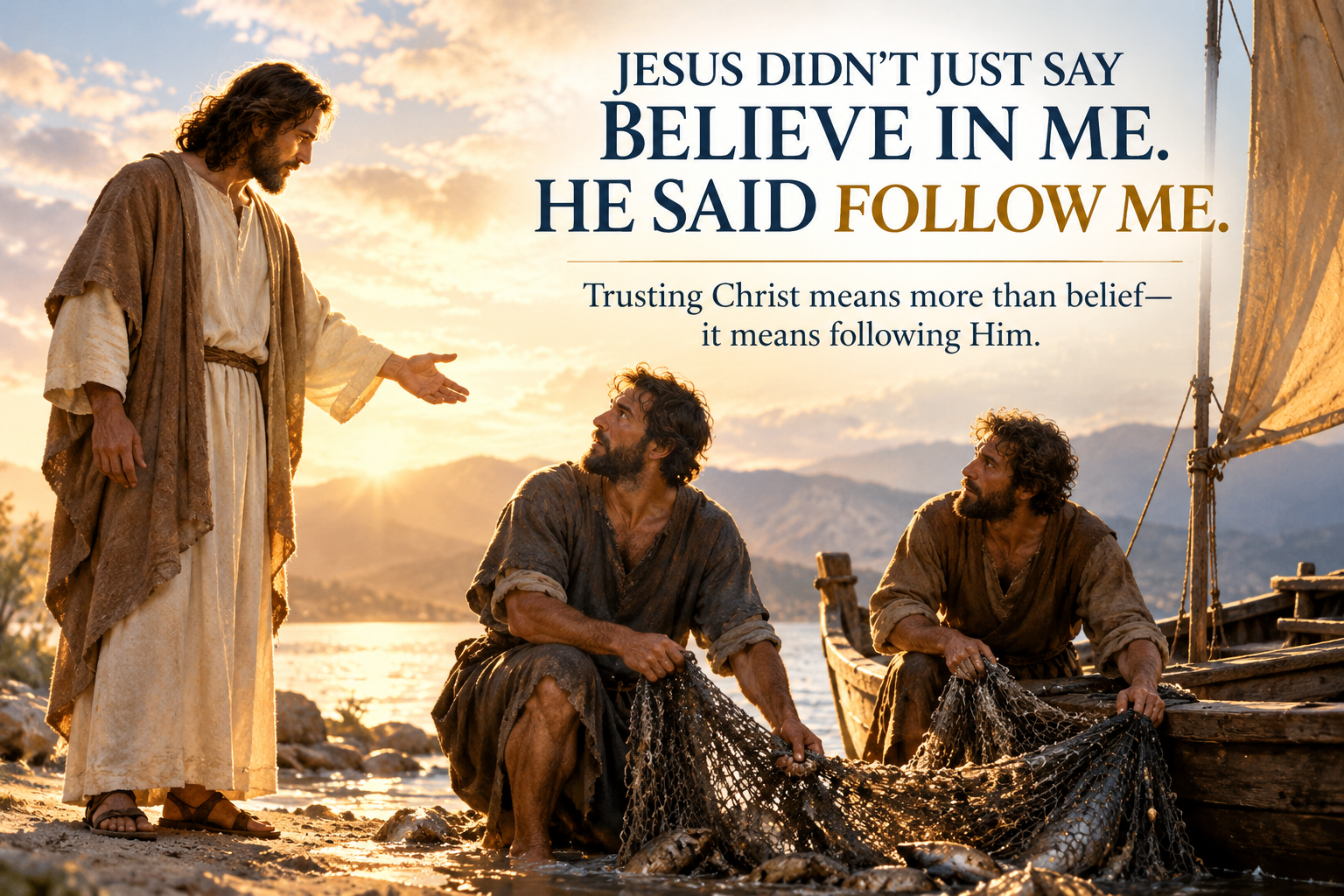
Sa buong Ebanghelyo, paulit-ulit na tinatawag ni Jesus ang mga tao upang sumunod sa Kanya. Iniwan nina Pedro at Andres ang kanilang mga lambat. Iniwan ni Mateo ang kanyang trabaho bilang maniningil ng buwis. Tinalikuran ng mga ordinaryong tao ang dati nilang pamumuhay upang maging Kanyang mga alagad.

Hindi lamang sila hinilingang maniwala sa ilang bagay tungkol sa Kanya. Inanyayahan silang ipagkatiwala ang kanilang buong buhay sa Kanya, at may kaakibat na pananagutan ang pagtitiwalang iyon.

Sinabi ni Jesus sa Kanyang mga alagad:

“Kung iniibig ninyo ako, tutuparin ninyo ang aking mga utos.” — Juan 14:15

Sa ibang pagkakataon, nagtanong Siya:

“Bakit ninyo ako tinatawag na ‘Panginoon, Panginoon,’ gayong hindi naman ninyo ginagawa ang sinasabi ko?” — Lucas 6:46

Isang tanong na dapat nating pag-isipan, lalo na kung naniniwala tayong sapat nang ipahayag ang ating pananampalataya kay Jesus nang hindi isinasaalang-alang ang Kanyang mga utos.

Isipin natin ang pagtitiwala sa pang-araw-araw na buhay. Kung sasabihin kong nagtitiwala ako sa aking doktor ngunit palagi kong binabalewala ang kanyang payo, tinatanggihan ang kanyang inirerekomendang paggamot, at mas pinipiling sundin ang sarili kong opinyon, gaano ba talaga kalaki ang tiwala ko sa kanya?

Maaaring hinahangaan ko ang kanyang kaalaman at naniniwala akong mahusay siyang doktor. Ngunit ipinakikita ng aking mga kilos na sa huli, mas pinagtitiwalaan ko pa rin ang sarili ko.

Maaari ring mangyari ito sa ating relasyon kay Cristo. Maaari nating buong-pusong sabihin na nagtitiwala tayo sa Kanya, ngunit pinananatili natin ang karapatang magpasya para sa ating sarili kung alin sa Kanyang mga aral ang ating tatanggapin.

Lalo itong nagiging mahalaga kapag inalala natin ang isang bagay na ginawa ni Jesus na madalas hindi nabibigyan ng sapat na pansin sa mga talakayan tungkol sa pananampalataya.

Nagtatag Siya ng isang Simbahan.

Hindi lamang naglakbay si Jesus sa Judea upang mangaral ng magagandang aral at hikayatin ang mga tao na magkaroon ng personal na relasyon sa Diyos. Pumili Siya ng labindalawang apostol, inihanda sila para sa kanilang misyon, binigyan ng kapangyarihan, at inutusang magturo at magbinyag sa Kanyang pangalan.

Bago Siya umakyat sa langit, iniutos Niya sa kanila na gawing alagad ang lahat ng mga bansa, binyagan sila, at turuang sumunod sa lahat ng Kanyang iniutos (Mateo 28:19–20).

Pansinin natin ang isang bagay. Hindi Niya sinabi sa mga apostol na magsulat ng isang aklat at hayaan ang mga susunod na henerasyon na alamin nang kanya-kanya kung ano ang tunay na Kristiyanismo.

Sa halip, nagtatag Siya ng isang Simbahang may tungkuling magturo, at nangakong mananatili Siyang kasama ng Kanyang mga alagad hanggang sa katapusan ng panahon.

Hindi nito binabawasan ang kahalagahan ng Banal na Kasulatan. Kinikilala ng mga Katoliko na ang Bibliya ay Salita ng Diyos na isinulat sa ilalim ng Kanyang inspirasyon. Ngunit ipinakikita mismo ng Bibliya na higit pa sa isang koleksiyon ng mga banal na kasulatan ang itinatag ni Cristo.

Nagtatag Siya ng isang nakikitang pamayanan ng mga mananampalataya sa ilalim ng pamumuno ng Kanyang mga apostol, ipinagkatiwala sa kanila ang Kanyang mga aral, at nangakong hindi mananaig laban sa Kanyang Simbahan ang kapangyarihan ng kamatayan (Mateo 16:18).

Ang pangakong iyon ay dapat magkaroon ng malaking kahulugan para sa sinumang nagsasabing nagtitiwala siya kay Cristo.

Ang Simbahan ay Hindi Kapalit ni Cristo

Isa sa pinakamahalagang talata sa Bagong Tipan tungkol sa Simbahan ay matatagpuan sa unang sulat ni San Pablo kay Timoteo. Inilarawan niya ang Simbahan bilang:

“Ang sambahayan ng Diyos na buhay, ang haligi at saligan ng katotohanan.” — 1 Timoteo 3:15

Napakahalaga ng paglalarawang ito. Hindi ipinakilala ni Pablo ang Simbahan bilang isang lugar lamang kung saan nagtitipon ang mga Kristiyanong nakapagpasya na para sa kanilang sarili kung ano ang kahulugan ng Kristiyanismo.

Inilarawan niya ang Simbahan bilang haligi at saligan ng katotohanan, na may pananagutang ingatan at tapat na ipasa sa mga susunod na salinlahi ang mga aral na ipinahayag ni Cristo.

Sa pananaw ng mga Katoliko, ito mismo ang dahilan kung bakit may awtoridad ang Simbahan. Hindi dahil laging matalino o banal ang mga pari at obispo, at lalong hindi dahil hindi sila nagkakamali sa kanilang mga personal na pasya. Maraming halimbawa sa kasaysayan ng Simbahan ng kahinaan, katiwalian, at pagkakasala ng mga tao.

Ang ating pagtitiwala sa awtoridad ng Simbahan sa pagtuturo ng pananampalataya ay hindi nakasalalay sa personal na kabanalan ng mga pinuno nito. Nakasalalay ito sa mga pangako ni Jesucristo.

Nang sabihin ni Jesus sa Kanyang mga isinugo, “Ang nakikinig sa inyo ay nakikinig sa akin, at ang tumatanggi sa inyo ay tumatanggi sa akin” (Lucas 10:16), may isang napakahalagang bagay Siyang ginawa. Binigyan Niya ng awtoridad ang mga taong hindi perpekto upang magsalita sa Kanyang pangalan.

Nauunawaan ng mga Katoliko na ang awtoridad na ito sa pagtuturo ay nagpapatuloy sa Simbahang itinatag ni Cristo sa pamamagitan ng paghalili sa mga apostol.

Dito rin natin mas mauunawaan kung bakit hindi ganoon kasimple ang madalas nating marinig na pahayag na, “Kay Jesus ako nagtitiwala, hindi sa relihiyon.”

Nauunawaan ko ang damdaming nasa likod nito, lalo na sa mga taong nasaktan o nadismaya dahil sa mga pinuno ng relihiyon. Ngunit kung si Jesus mismo ang nagtatag ng Simbahan, nagkatiwala rito ng Kanyang mga aral, at nagbigay ng awtoridad upang gabayan ang Kanyang mga tagasunod, hindi ba may problemang kailangang pag-isipan kung tatanggihan natin ang awtoridad na iyon sa ngalan ng pagtitiwala kay Jesus?

Siyempre, dapat nating siyasatin kung ang Simbahang Katolika nga ba ang Simbahang itinatag ni Cristo. Isa itong makatuwirang tanong tungkol sa kasaysayan at pananampalataya, na mas malawak kong tinalakay sa artikulong When Did the Catholic Church Begin?.

Ngunit kung totoo ang pag-aangking iyon, ang pagtitiwala sa awtoridad na ibinigay ni Cristo sa Kanyang Simbahan ay hindi pagtalikod sa pagtitiwala sa Kanya. Isa itong pagpapahayag ng pagtitiwalang iyon.

Si Cristo Ba ang Ating Pinagtitiwalaan, o ang Sarili Nating Pagpapakahulugan sa Kanya?

Dito nagiging mas kawili-wili ang usapan.

Kung tatanungin natin ang ilang Kristiyano kung ano ang ibig sabihin ng pagtitiwala kay Jesus, malamang na marami silang pagkakasunduan. Magsasalita sila tungkol sa pananampalataya, kapatawaran, pagsisisi, pagsunod, at pagsuko ng kanilang buhay sa Diyos.

Ngunit kapag nagtanong tayo tungkol sa mga partikular na aral ni Jesus, maaaring mabilis na mawala ang pagkakasunduang iyon.

Kailangan ba ang binyag para sa kaligtasan, o isa lamang itong panlabas na simbolo ng pananampalatayang mayroon na ang isang tao? Nang sabihin ni Jesus na kailangan nating kainin ang Kanyang laman at inumin ang Kanyang dugo, literal ba o simboliko ang Kanyang ibig sabihin? Binigyan ba Niya ang Kanyang mga apostol ng kapangyarihang magpatawad ng mga kasalanan? Maaari bang mawala ang kaligtasan?

Hindi maliliit na bagay ang mga tanong na ito. May kinalaman ang mga ito sa kung paano natin nauunawaan ang kaligtasan, tinatanggap ang biyaya ng Diyos, at isinasabuhay ang ating pananampalataya.

Gayunman, ang mga Kristiyanong tapat at may mabuting hangarin, na kadalasan ay iisang Bibliya ang binabasa, ay nakararating sa magkakaibang konklusyon.

May magsasabi, “Bumalik na lang tayo sa Bibliya.”

Sang-ayon ako na dapat tayong bumaling sa Banal na Kasulatan. Ngunit hindi nito awtomatikong nalulutas ang hindi pagkakasundo, dahil pareho namang nagbabasa ng Bibliya ang dalawang panig.

Hindi naman kinakailangang pinagtatalunan nila kung totoo ang Bibliya. Ang kanilang hindi pagkakasundo ay tungkol sa kahulugan ng mga nakasulat dito.

Maaari nating pag-aralan ang orihinal na mga wika, ang konteksto ng kasaysayan, ang mga paliwanag ng mga dalubhasa, at ang mga isinulat ng mga unang Ama ng Simbahan. Mahahalagang paraan ang mga ito upang palalimin ang ating pagkaunawa.

Ngunit sa huli, kailangan pa ring matukoy kung aling pagpapakahulugan ang tama at kung mayroon itong awtoridad na dapat sundin ng ibang mga Kristiyano.

Kung ang bawat indibidwal na Kristiyano ang may huling kapangyarihang magpasya kung ano ang ibig sabihin ng Banal na Kasulatan, hindi natin tunay na inalis ang awtoridad ng tao. Inilipat lamang natin ito mula sa Simbahan patungo sa ating sarili.

At dito makikita ang kabalintunaan.

Maaaring buong-pusong sabihin ng isang Kristiyano, “Hindi ako nagtitiwala sa awtoridad ng Simbahan. Kay Cristo lamang ako nagtitiwala.”

Ngunit kung ang tanging batayan niya sa pagtukoy sa mga aral ni Cristo ay ang sarili niyang pagpapakahulugan sa Bibliya, paano niya malalaman kung si Cristo nga ang kanyang sinusunod at hindi lamang ang sarili niyang pagkaunawa kay Cristo?

Hindi ko kinukuwestiyon ang katapatan ng sinuman. Naniniwala akong karamihan sa mga Kristiyano ay tunay na naghahangad na sumunod kay Jesus. Ngunit ang pagiging tapat sa ating paniniwala ay hindi sapat upang malaman kung tama ang ating interpretasyon, at hindi kusang ipinapaliwanag ng Bibliya ang sarili nito.

Ito ang dahilan kung bakit napakahalaga ng tanong tungkol sa kung sino ang may awtoridad na magpaliwanag ng Banal na Kasulatan. Hindi lamang ito isa pang pagkakaiba sa mga aral ng iba’t ibang Kristiyano. Ito ang tanong na nasa likod ng halos lahat ng kanilang mga hindi pagkakasundo.

At may mahalagang tanong din itong ibinabato sa paniniwalang ang Bibliya lamang ang pinakamataas at tanging hindi nagkakamaling tuntunin ng pananampalataya: Kanino ipinagkatiwala ni Cristo ang awtoridad na turuan ang Kanyang mga tagasunod?

Magtiwala Kay Cristo nang May Kababaang-Loob ng Isang Bata

Isa sa mga bagay na nagbibigay sa akin ng kapanatagan tungkol sa pananampalatayang Katoliko ay ang katotohanang hindi ginawa ni Jesus na nakasalalay ang ating kaligtasan sa kakayahan nating maging mga dalubhasa sa Bibliya.

Sa malaking bahagi ng kasaysayan ng Kristiyanismo, maraming karaniwang mananampalataya ang hindi marunong bumasa. Napakamahal ng mga aklat, at hindi madaling magkaroon ng sariling kopya ng Bibliya. Gayunman, lumaganap ang Kristiyanismo sa buong Imperyong Romano at maging sa mga lupain sa labas nito sa pamamagitan ng pangangaral, pagsamba, at buhay-sakramento ng Simbahan.

Ang mga Kristiyano ay binibinyagan, tinuturuan sa pananampalataya, nagtitipon para sa Eukaristiya, at natututong sumunod kay Jesus bilang bahagi ng pamayanang Kanyang itinatag.

Hindi nila kailangang maging dalubhasa sa Griyego o Hebreo, o lutasin nang mag-isa ang bawat pagtatalo tungkol sa teolohiya. Kailangan nilang tanggapin at isabuhay ang pananampalatayang ipinagkatiwala ni Cristo sa Kanyang Simbahan.

Hindi ibig sabihin nito na dapat tumigil ang mga Kristiyano sa pag-aaral ng Bibliya o sa pagtatanong tungkol sa kanilang pananampalataya. Sa katunayan, mahalagang bahagi ng ating paglago bilang Kristiyano ang paghahangad na higit na maunawaan ang mga aral ng Diyos.

Ngunit magkaiba ang pagsisikap na maunawaan ang katotohanang ipinahayag ni Cristo at ang pag-aakalang tayo mismo ang may huling awtoridad na magpasya kung ano ang kahulugan ng Kristiyanismo.

Madalas kong maisip ang sinabi ni Jesus na kung hindi tayo magbabago at magiging tulad ng maliliit na bata, hindi tayo makapapasok sa kaharian ng langit (Mateo 18:3).

Hindi naman kilala ang mga bata dahil sa kanilang malawak na kaalaman. Umaasa sila sa iba upang gabayan at turuan sila. Hindi kailangang maunawaan ng isang bata ang lahat bago siya magtiwala sa isang taong karapat-dapat sa kanyang pagtitiwala.

Marahil ay may mahalagang aral dito para sa mga Kristiyano ngayon.

Nasanay na tayong isipin na ang bawat tao ay dapat magpasya para sa kanyang sarili kung ano ang itinuturo ng Kristiyanismo, kaya kung minsan ay nakakalimutan natin ang kababaang-loob na kailangan upang tanggapin ang isang pananampalatayang hindi naman tayo ang lumikha.

Inaanyayahan tayo ng pananampalatayang Katoliko na kilalaning matagal nang umiiral ang Kristiyanismo bago pa tayo isinilang, at naglaan si Cristo ng paraan upang mapangalagaan at maipasa nang tapat ang Kanyang mga aral.

Malaya tayong siyasatin ang pag-aangking iyon, magtanong, at magsikap na maunawaan ito. Ngunit kung matutuklasan nating tunay ngang nagtatag si Cristo ng isang Simbahang may awtoridad, hinihingi ng kababaang-loob na isaalang-alang natin kung ang pagsunod sa Kanya ay nangangahulugan ding pagtanggap sa awtoridad na iyon.

Hindi naman dapat maging hadlang ang Simbahan sa pagitan natin at ni Cristo, na para bang isa siyang hiwalay na tagapagligtas.

Si Cristo lamang ang nagliligtas. Ang misyon ng Simbahan ay ipahayag Siya, ipamahagi ang Kanyang biyaya sa pamamagitan ng mga sakramento, at gabayan ang Kanyang mga tagasunod sa katotohanang Kanyang ipinahayag.

Ang awtoridad ng Simbahan ay nagmumula kay Cristo at umiiral upang maglingkod sa Kanya.

Kaya Ano Ba Talaga ang Ibig Sabihin ng Magtiwala Kay Cristo Lamang?

Balikan natin ang ating unang tanong.

Kung ang ibig sabihin ng pagtitiwala kay Cristo lamang ay Siya ang ating tanging Tagapagligtas, na ang kaligtasan ay kaloob ng biyaya ng Diyos at hindi isang bagay na maaari nating bilhin o kitain sa sariling pagsisikap, at na nararapat Siyang sundin nang buong pananampalataya, buong-pusong sasang-ayon ang mga Katoliko.

Ngunit kung ang ibig sabihin nito ay dapat nating tanggihan ang awtoridad ng Simbahang Kanyang itinatag at umasa lamang sa sarili nating pagpapakahulugan sa Kanyang mga aral, kailangan nating itanong kung saan itinuro ni Jesus ang ganoong paniniwala.

Ang Jesus na matatagpuan natin sa Banal na Kasulatan ay hindi basta nagsabi sa Kanyang mga tagasunod na maniwala sa Kanya at pagkatapos ay alamin nang kanya-kanya kung ano ang tunay na Kristiyanismo. Tinawag Niya silang sumunod sa Kanya, itinatag ang Kanyang Simbahan, ipinagkatiwala ang Kanyang mga aral sa mga apostol, at nangakong mananatili Siyang kasama nila hanggang sa katapusan ng panahon.

Hindi ko kailangang maniwala na banal ang bawat pari, matalino ang bawat obispo, o perpekto ang bawat desisyong ginagawa ng mga pinuno ng Simbahan. Ang kailangan kong pagkatiwalaan ay na alam ni Jesucristo ang Kanyang ginagawa nang itatag Niya ang Kanyang Simbahan at na nananatili Siyang tapat sa Kanyang mga pangako.

Marahil ang tunay na tanong ay hindi kung dapat ba tayong magtiwala kay Cristo lamang. Marahil ang tanong ay kung handa ba tayong magtiwala kay Cristo nang sapat upang sundin Siya ayon sa Kanyang kalooban, sa halip na ayon lamang sa sarili nating kagustuhan.

Sapagkat ang pagtitiwala kay Jesus at ang pagtitiwala sa sarili nating pagpapakahulugan tungkol kay Jesus ay hindi palaging iisa.


Catholics Are Wrong—Says Who?

One Question that needs to be answeredKung may nagsabi na sa iyo na mali ang mga Katoliko tungkol sa kaligtasan, binyag, kumpisal, Eukaristiya, o awtoridad ng Simbahan, marahil ay napansin mo kung gaano kabilis nauuwi ang usapan sa palitan ng mga talata mula sa Bibliya.

Parehong sumisipi sa Banal na Kasulatan ang dalawang panig, at pareho silang naniniwalang tama ang kanilang pagpapakahulugan.

Ngunit may isang tanong na madalas hindi napag-uusapan: Sino ang may awtoridad na magpasya kung ano talaga ang itinuturo ng Kristiyanismo?

Iyan ang pangunahing tanong sa aking aklat na Catholics Are Wrong—Says Who?

Isinulat ko ito para sa mga ordinaryong Katoliko, hindi lamang para sa mga teologo o dalubhasa sa Bibliya. Hindi mo kailangang magsaulo ng daan-daang talata o maging eksperto sa kasaysayan ng Simbahan upang maunawaan ang pundasyon ng iyong pananampalataya.

Kung minsan, ang kailangan lamang ay kaunting sentido komun, kahandaang magtanong ng mga tamang tanong, at ang payak na pananampalatayang tulad ng sa isang bata na itinuro ni Jesus.

Bago natin tanggaping mali ang mga Katoliko, marahil ay dapat muna nating itanong:

Sabi nino?

Alamin ang tungkol sa aklat na Catholics Are Wrong—Says Who? →

Bill Moran | Tagapagtatag ng WhyCatholic.com
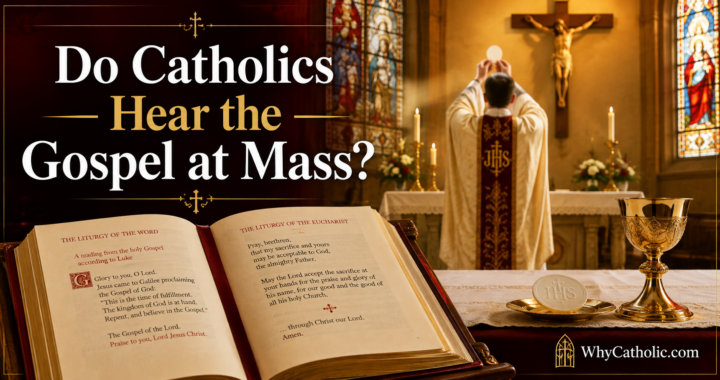
Jesus calls His apostles to follow Him, illustrating what it means to trust Christ and His Church.

What Does It Really Mean to Trust in Christ Alone?

If we truly trust Jesus, shouldn’t we also trust the Church He established?

“Just trust in Christ alone.”

It’s a beautiful expression we hear often from Evangelical Christians, especially when discussing salvation. And who could disagree? Of course we should trust Christ. He is our Savior, our Redeemer, the way, the truth, and the life. But as I’ve heard Christians use this expression over the years, I’ve often wondered whether we’ve given it enough thought.

What does it mean to trust Jesus? Is it enough to believe He died for our sins and accept Him as our personal Savior? Does trust involve obedience, following His teachings, and accepting what He asks of us, even when we don’t fully understand or agree?

I suspect most Christians would acknowledge that genuine trust involves more than simply believing certain things about Jesus. After all, as St. James reminds us, even the demons believe in God (James 2:19). The difference is that genuine faith calls us into a relationship with Christ, one that necessarily involves following Him.

And that’s where I think the familiar expression trust in Christ alone raises an interesting question. If we are going to trust Christ, shouldn’t we also trust the means He established for us to follow Him?

Jesus Didn’t Just Say, Trust me alone or believe in me, He said Follow Me.

Jesus calls His apostles to follow Him, illustrating what it means to trust Christ and His Church.Throughout the Gospels, Jesus calls people to follow Him. Peter and Andrew leave their fishing nets, Matthew leaves his tax collector’s booth, and ordinary people abandon their former lives to become His disciples. Jesus doesn’t simply ask them to believe certain things about Him. He invites them to entrust their lives to Him, and that trust carries expectations.

“If you love me, you will keep my commandments,” He tells His disciples (John 14:15). Elsewhere, He asks, “Why do you call me ‘Lord, Lord,’ and not do what I tell you?” (Luke 6:46).

It’s a rather uncomfortable question, especially for anyone who believes that professing faith in Jesus is sufficient without considering what He actually commands.

Consider what trust means in an ordinary relationship. If I tell my physician I trust him but routinely disregard his advice, reject his treatment, and substitute my own medical opinions, how much am I really trusting him? I might admire his intelligence and believe he’s an excellent physician, but my actions suggest that when it comes to deciding what is best, I ultimately trust myself.

Something similar can happen in our relationship with Christ. We can sincerely profess our trust in Him while reserving the right to decide for ourselves which of His teachings we’re willing to accept. And this becomes particularly important when we consider something Jesus did that is frequently overlooked in discussions about faith.

He established a Church.

Jesus didn’t simply travel around Judea preaching inspiring sermons and encouraging people to develop a personal relationship with God. He chose twelve apostles, prepared them for their mission, gave them authority, and commissioned them to teach and baptize in His name.

Before His Ascension, He instructed them to make disciples of all nations, baptizing them and teaching them to observe everything He had commanded (Matthew 28:19–20). Notice that He didn’t tell them to write a book and leave future generations to figure out Christianity independently. He established a teaching Church and promised to remain with His disciples until the end of the age.

This doesn’t diminish the importance of Scripture. Catholics recognize the Bible as the inspired Word of God. But the Bible itself reveals that Christ established something more than a collection of sacred writings. He established a visible community of believers under the leadership of His apostles, entrusted them with His teachings, and promised that the gates of hell would not prevail against His Church (Matthew 16:18).

That promise ought to mean something to anyone who claims to trust Christ.

The Church Is Not a Substitute for Christ

One of the most revealing passages in the New Testament appears in St. Paul’s first letter to Timothy, where he describes the Church as “the church of the living God, the pillar and bulwark of the truth” (1 Timothy 3:15).

That’s an extraordinary description. Paul doesn’t present the Church as an optional gathering place for Christians who have already determined for themselves what Christianity means. He describes her as the pillar and foundation supporting the truth, entrusted with preserving and faithfully transmitting what Christ revealed.

From the Catholic perspective, this is precisely why the Church possesses authority. Not because priests and bishops are always wise or holy, and certainly not because they are incapable of making mistakes. Church history provides more than enough evidence of human weakness, corruption, and scandal. Our confidence in the Church’s teaching authority doesn’t rest upon the personal virtue of her leaders, but upon the promises of Jesus Christ.

When Jesus tells His apostles, “He who hears you hears me, and he who rejects you rejects me” (Luke 10:16), He is doing something remarkable. He is authorizing imperfect human beings to speak in His name. The Catholic understanding is that this apostolic teaching authority continues in the Church Christ established.

This also helps explain why the familiar expression “I trust Jesus, not religion” is more complicated than it sounds. I understand the sentiment, especially among people who have been disappointed or wounded by religious institutions. But if Jesus Himself established a Church, entrusted her with His teachings, and gave her authority to guide His followers, then rejecting that authority in the name of trusting Jesus presents a contradiction worth examining.

Of course, we must establish whether the Catholic Church really is the Church Christ founded. That’s a legitimate historical and theological question, one I’ve explored elsewhere in When Did the Catholic Church Begin?. But if that claim is true, then trusting the Church’s divinely established authority isn’t a departure from trusting Christ. It’s an expression of that trust.

Are We Trusting Christ Alone or Our Interpretation of Christ?

Here’s where I think the conversation becomes particularly interesting.

Ask a group of Christians what it means to trust Jesus and you’ll hear considerable agreement. They’ll speak about faith, forgiveness, repentance, obedience, and surrendering their lives to God. But begin asking more specific questions about what Jesus taught, and those agreements often disappear.

Is baptism necessary for salvation, or merely an outward symbol of something that has already happened? When Jesus said we must eat His flesh and drink His blood, was He speaking literally or symbolically? Did Christ give His apostles authority to forgive sins? Can salvation be lost?

These aren’t trivial matters. They concern the very means by which Christians understand salvation, receive God’s grace, and live their faith. Yet sincere Christians, often reading the very same Scriptures, reach radically different conclusions.

Someone will inevitably respond, “We simply need to go back to the Bible.” And I agree that we should turn to Scripture. But that response doesn’t actually resolve the disagreement, because both individuals are already reading the Bible. Their disagreement isn’t necessarily about whether Scripture is true. It’s about what Scripture means.

We can study the original languages, examine historical context, consult biblical scholars, and read the early Church Fathers. These are valuable ways to deepen our understanding. But eventually someone must decide which interpretation is correct and whether that interpretation is binding upon other Christians.

If every individual Christian possesses the final authority to decide what Scripture means, then we haven’t really eliminated human authority. We’ve simply relocated it from the Church to ourselves.

And therein lies the irony. Someone may sincerely insist, “I don’t trust the authority of the Church. I trust Christ alone.” But if he determines what Christ teaches exclusively through his own interpretation of Scripture, how does he know that he is trusting Christ rather than his own understanding of Christ?

I’m not questioning anyone’s sincerity. I believe most Christians genuinely want to follow Jesus faithfully. But sincerity alone doesn’t settle competing interpretations, and the Bible doesn’t interpret itself.

That’s why the question of who has the authority to interpret Scripture is so important. It isn’t simply another theological disagreement among many. It underlies virtually every disagreement Christians have about what Christ taught.

And it raises a question that the doctrine of the Bible alone must ultimately address: Where did Christ place the authority to teach His followers?

Trusting Christ With the Humility of a Child

One of the things I find most reassuring about the Catholic faith is that Jesus didn’t make salvation dependent upon our ability to become biblical scholars.

For most of Christian history, ordinary believers couldn’t read, books were expensive, and personal copies of Scripture weren’t readily available. Yet Christianity spread throughout the Roman Empire and beyond through the preaching, worship, and sacramental life of the Church.

Christians were baptized, instructed in the faith, gathered for the Eucharist, and learned to follow Jesus within the community He established. They didn’t need to master Greek or Hebrew or independently resolve every theological controversy. They needed to receive the faith entrusted to the Church and live it.

None of this means Christians should stop studying Scripture or asking difficult questions. Quite the opposite. Understanding our faith is an important part of growing in it. But there’s a difference between seeking to understand what Christ has revealed and assuming that each of us possesses the final authority to determine what Christianity means.

I often think about Jesus telling His followers that unless they become like little children, they will never enter the kingdom of heaven (Matthew 18:3).

Children aren’t known for their superior knowledge or intellectual sophistication. They depend upon others to guide and teach them. A child doesn’t need to understand everything before trusting someone worthy of that trust.

Perhaps there’s a lesson here for Christianity today. We’ve become so accustomed to thinking that each person must decide for himself what Christianity teaches that we sometimes overlook the humility involved in receiving a faith we did not invent.

The Catholic faith asks us to recognize that Christianity existed long before we arrived and that Christ provided a means by which His teachings could be faithfully preserved and handed down. We are free to investigate that claim, question it, and seek to understand it. But if we discover that Christ really did establish an authoritative Church, humility requires us to consider whether following Him includes accepting that authority.

After all, the Church isn’t supposed to stand between us and Christ as some competing source of salvation. Christ alone saves. The Church’s mission is to proclaim Him, communicate His grace through the sacraments, and guide His followers in the truth He revealed.

Her authority, properly understood, comes from Him and exists to serve Him.

So What Does It Really Mean to Trust Christ Alone?

Let’s return to where we started.

If trusting Christ alone means that Jesus is our only Savior, that salvation is a gift of God’s grace rather than something we can earn, and that we owe Him our complete faith and obedience, Catholics can say amen to all of that.

But if trusting Christ means rejecting the authority of the Church He established and relying upon our own interpretation of His teachings, I think we have to ask where Jesus told us to do that.

The Jesus we encounter in Scripture didn’t simply tell His followers to believe in Him and then figure out Christianity for themselves. He called them to follow Him, established His Church, entrusted His teachings to His apostles, and promised to remain with them until the end of the age.

I don’t need to believe that every priest is holy, every bishop is wise, or every decision made by Church leaders is perfect. I need to trust that Jesus Christ knew what He was doing when He established His Church and that He remains faithful to His promises.

Perhaps the real question isn’t whether we should trust Christ alone. Perhaps it’s whether we’re willing to trust Christ enough to follow Him on His terms rather than our own.

Because trusting Jesus and trusting our own interpretation of Jesus are not necessarily the same thing.


Catholics Are Wrong—Says Who?

One Question that needs to be answeredIf you’ve ever been told that Catholics are wrong about salvation, baptism, confession, the Eucharist, or the authority of the Church, you’ve probably noticed how quickly these conversations become an exchange of Bible verses. Both sides quote Scripture, and both insist their interpretation is correct.

But there’s a question that often gets overlooked: Who has the authority to determine what Christianity actually teaches?

That’s the question at the heart of my book, Catholics Are Wrong—Says Who?

I wrote it for ordinary Catholics, not theologians or biblical scholars. You don’t have to memorize hundreds of Bible verses or become an expert in Church history to understand the foundations of your faith. Sometimes all it takes is a little common sense, a willingness to ask the right questions, and the childlike faith Jesus encouraged.

Before accepting that Catholics are wrong, perhaps we ought to ask: Says who?

Discover Catholics Are Wrong—Says Who?

Bill Moran | Founder, WhyCatholic.com

I Was Once A Catholic…

once catholic

“I was a Catholic once,” said the lady a few yards from me in the parking lot. “Now I’m a Christian and you can be one as well.” She handed a tract to a gentleman standing next to the open trunk of his car. I couldn’t help it.

“Excuse me,” I said to the lady, “but could I too have a tract?” The lady’s face beamed. “Are you saved?” she asked. “Of course I am; I’m a believing Catholic,” I retorted. She looked at me as if I had bad breath or something.

She continued, “I was just telling this gentleman that I too was a Catholic – a Catholic for thirty-some years in fact. Now I’ve found Christ and I’m trying to tell everyone I know about salvation through Christ.”

“Wow, that’s really something! May I ask why you left the Church?” I could tell that, by asking this question, my new acquaintance was getting excited. After all, she had probably been snubbed by dozens of people, and now she had someone that she could “witness” to.

“You see,” she said, “I was born Catholic. I attended Mass every week, received the Sacraments and graduated from a Catholic school. Not once did I ever hear the gospel proclaimed. Not once! It was after the birth of my first child that a good friend of mine shared ‘the gospel’ with me and I accepted Jesus as my personal Lord and Savior and became a Christian. Now I belong to a ‘Bible-believing’ church, and I’m sharing the gospel with whoever will listen.”

This shocked me. “You mean you belonged to the Catholic Church for over forty years and you never heard the gospel?,” I said. She was getting more excited. “Yes, I never once heard the gospel of salvation preached or taught or even mentioned in the Church. If you don’t preach the gospel, excuse my bluntness, but you’re simply not Christian.” I scratched my head and said, “that’s strange. I’ve been a Catholic all my life and I bet I hear the gospel every week at Church.” Her smile quickly faded into a look of curiosity. “Maybe, I’m missing something,” I continued. “Tell me what you mean by ‘the gospel?’”

The lady reached back into her purse to pull out a little tract and said, “This tract explains the simple gospel of salvation. It can be broken down into four easy steps.

  1. First, we acknowledge that we are all sinners in need of God’s forgiveness
  2. Secondly, we recognize that only God can save us
  3. The third step is that Jesus Christ died on the Cross for our sins and to bring us to God.
  4. And the fourth and final step is that each individual accepts Jesus Christ as their personal Lord and Savior to be saved

I thought for a couple of seconds and said, “If I could demonstrate to you that Catholics hear “the gospel” every Sunday, would you agree to take a closer look at the Catholic Church?” Now, she knew she had me over a barrel. “Prove it,” she said. I excused myself for a second and ran to my car to grab a Missal.
“Since you have attended Mass nearly all your life, you probably remember these prayers.” I flipped open to the beginning prayers of the Mass and proceeded to show her how Catholics hear, pray, and live the gospel message every Sunday.

The first step in my new found friend’s tract stated that we are all sinners in need of God’s forgiveness. After the Greeting, the Mass continues to what is known as the Penitential Rite. I read aloud the text to her while she followed, reading silently.

“I confess to almighty God, and to you, my brothers and sisters, that I have sinned through my own fault. In my thoughts and in my words, in what I have done, and in what I have failed to do.”

woman listening to the gospel at catholic mass

I mentioned that it is here in this section that each Catholic states publicly that he or she is individually a sinner – not merely in a general sense – but specifically in thoughts, words and deeds. You can’t get much more complete than that. I continued reading,
“and I ask Blessed Mary, ever virgin, all the angels and saints, and to you, my brothers and sisters, to pray for me to the Lord our God.”
The priest reaffirms this confession of sin by praying:

“May almighty God have mercy on us, forgive us our sins, and bring us to everlasting life.”
And the whole congregation says “Amen,” that is, “I believe.”

The priest continues. “Lord have mercy, Christ have mercy, Lord have mercy,”
and finishes by saying; “Lord show us your mercy and love. And grant us your salvation.”

I looked at her and said, “You see, we Catholics start every Mass with a public declaration of our own personal sinfulness and look to God for forgiveness.” She responded, “But Catholics don’t believe that God alone can save them. They believe Mary and the saints will save them.” I shook my head in disagreement. “No, we don’t. Remember what we had just read in the Mass. Catholics ask Mary, the angels, the saints, and the whole congregation to pray to God for mercy on their behalf – just like I would ask you to pray for me to God. Does that mean that I look to you to ‘save’ me? No, of course, I don’t believe that. I’m just asking for your help. Besides the ‘Gloria’ of the Mass proves that Catholics look to God alone to save us.”

I began reading the Missal emphasizing certain words to prove my point:

“Glory to God in the highest, and peace to his people on earth. Lord God, heavenly King, almighty God, and Father, we worship you, we give you thanks, we praise you for your glory. Lord Jesus Christ, only Son of the Father, Lord God, Lamb of God, you take away the sin of the world, have mercy on us, you are seated at the right hand of the Father, receive our prayer. For you alone are the Holy One, you alone are the Lord, you alone are the Most High, Jesus Christ, with the Holy Spirit, in the glory of God the Father.”

Likewise, the doxology spoken just prior to communion reads:

“Through him, with him, in him; in the unity of the Holy Spirit, all glory and honor is yours, almighty Father, forever and ever.”

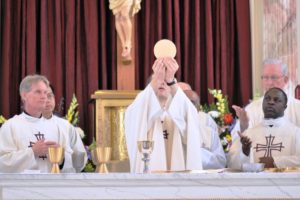
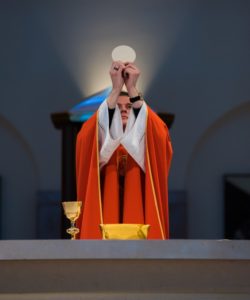
priest elevating the eucharist during catholic mass

As I looked up, I could see the lady intently reading the page. She couldn’t believe that she had prayed these prayers for years and never noticed what it was saying. Yet, there it was in black and white. I continued with the third step – the acknowledgment that Jesus Christ died on the cross for our sins and to bring us to God.
The Profession of Faith reads,
“For us men and for our salvation, he came down from heaven: by the power of the Holy Spirit, he was born of the Virgin Mary, and became man. For our sake, he was crucified under Pontius Pilate.”

In the Eucharistic Prayer 1, the priest prays:
“Remember [Lord] all of us gather here before you. You know how firmly we believe in you and dedicate ourselves to you. . . We pray to you, our living and true God, for our well-being and redemption . . . Grant us your peace in this life, save us from final damnation, and count us among those you have chosen.”
The prayer ends with an appeal to God for salvation through Jesus Christ:
“May, these and all who sleep in Christ, find in your presence light, happiness and peace. For ourselves, too, we ask some share in the fellowship of your apostles and martyrs . . . Though we are sinners, we trust in your mercy and love. Do not consider what we truly deserve, but grant us your forgiveness. Through Christ our Lord you give us all these gifts. You fill them with life and goodness, you bless them and make them holy.”

Similarly, the Eucharistic Prayer 2 proclaims,
“Dying you [Jesus] destroyed our death, rising you restored our life. Lord Jesus, come in glory. . . Have mercy on us all; make us worthy to share eternal life with Mary, the virgin Mother of God, with the apostles and with all the saints who have done your will throughout the ages.”

Likewise, Eucharistic Prayer 3 reads,
“All life, all holiness comes from you through your Son, Jesus Christ our Lord, by the working of the Holy Spirit . . .
Father, calling to mind the death your Son endured for our salvation, his glorious resurrection, and ascension into heaven, and ready to greet him when he comes again, we offer you in thanksgiving this holy and living sacrifice. Look with favor on our your Church’s offering, and see the Victim [Christ] whose death has reconciled us to yourself . . .
May he make us an everlasting gift for you and enable us to share in the inheritance of your saints . . . “

Lastly, the Eucharistic Prayer 4 reads,
“Father, you so loved the world that in the fullness of time you sent your only Son to be our Savior . . .
In fulfillment of your will he gave himself up to death; but by rising from the dead, he destroyed death and restored life.”

In this prayer, the congregation proclaims the mystery of faith:

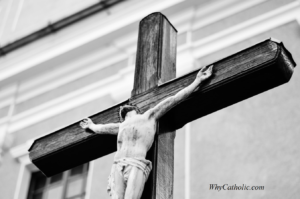
“Lord, by your cross and resurrection, you have set us free. You are the Savior of the world.” cross and resurrection

“You see, every week Catholics proclaim that Jesus died for them,” I said to the lady who was now searching for something to say. After a brief moment of silence, she shot a response back at me.
“What about accepting Jesus Christ and their personal Lord and Savior?” She retorted. “They may be saying all this stuff, but they don’t make a personal act of acceptance.” What she didn’t know was that I deliberately didn’t mention the last “step” of her “gospel.”

I explained that if Catholics don’t believe what they are praying, they ought not to be publicly proclaiming it. Since we can’t read the dispositions of other people’s hearts, we ought not to judge whether they truly believe what they are saying. Next, I pointed out the last step – where Catholics are accepting Jesus into their hearts. Right before communion the priest holds up the host (which is now the body, blood, soul, and divinity of Our Lord under the appearances of bread and wine) and prays.

Lamb of God“This is the Lamb of God, who takes away the sins of the world. Happy are those who are called to his supper.”

And the congregation responds,
“Lord, I am not worthy to receive you, but only say the word and I shall be healed.”
I looked straight into the lady’s eyes and said, “It is here that all those who are prepared to receive Jesus Christ walk up to the front of the church but they don’t just believe in Christ or merely asking Jesus into their hearts.” “They don’t?” She asked. “No,” I answered, “they receive that same Christ who died on the cross on Calvary into their mouth and into their stomachs – body, blood, soul, and divinity – and become one with him in an unspeakable way. Now that’s accepting Christ!” She didn’t have a response. I’m not sure that she had ever really thought about the Mass and Christ’s real presence in the Eucharist because she appeared to be both surprised and intrigued.

I gave her my phone number and invited her to a study group I was heading in the neighborhood which examined the Biblical foundation for Catholic doctrine. As we departed, I couldn’t help but wonder how many other people, like my new friend, left the Church thinking that it had nothing to say about salvation. Yet the richness of the liturgy of the Mass and even more so Christ’s real substantial presence in the Eucharist so outshines our separated brethren’s “low church” prayer services that there is no comparison!

Why Leah Remini Could Not Convert Kevin James

Leah Remini is best known for her role as Carrie Heffernan, the wife of Doug Heffernan, played by Kevin James.  Although Remini was baptized Catholic, she was raised in the religion of Scientology by her mother since the age of eight. Prior to becoming an apostate, Leah was a dedicated member and, as a teenager, even spent a year in Scientology’s elite Sea Org headquarters in Clearwater, Florida, where she performed manual labor.

In a 2015 interview with People magazine, Remini said she is finding comfort in Catholicism and that her exploration of Catholicism is a return to her roots. We are praying for her reversion to the one true faith.

Although Scientology church officials have denied it, Remini claims she was instructed to try and convert Kevin James to Scientology. Converting people we know to follow a belief system we feel is truthful or helpful is not surprising.  Leah said,  “They always tried to get me to, asking, ‘Why is he not in? Why have you not promoted it to him?’ I was like, ‘Because he’s Catholic. He doesn’t want anything to do with it,'” What is so hard to understand, he is happy”.

That little exchange points to a much bigger question. Kevin James was not simply choosing one religion over another; ultimately, every religious claim forces us to ask who has the authority to tell us what is true. For Christians, that question of authority may be more important than any single doctrinal argument.

James is a devout Catholic and has been in the public eye, first with “The King of Queens” and a series of comedies including “Hitch,” “Paul Blart: Mall Cop,” “Zookeeper” and “Grown-Ups”.

Kevin gave an in-depth interview to Raymond Arroyo at EWTN a number of years ago. You can see it at Catholic Celebrities 

Leah defected from Scientology in 2013. Since then she has made it her mission to expose the alleged abuses (both physical and psychological) and harassment perpetrated by the cult-like religion’s leadership—including its chief David Miscavige and his best pal Tom Cruise. Her primary platform is Leah Remini: Scientology and the Aftermath, an Emmy-winning A&E docuseries that brings the horror stories of ex-Scientologists to light.

There will always be someone eager to tell Catholics why their Church is wrong. But before arguing about Mary, the Eucharist, the papacy, or any other Catholic teaching, there is a more basic question: says who? That is the question behind Catholics Are Wrong… Says Who?—and once you understand the authority question, the rest of the Catholic-Protestant debate begins to look very different.

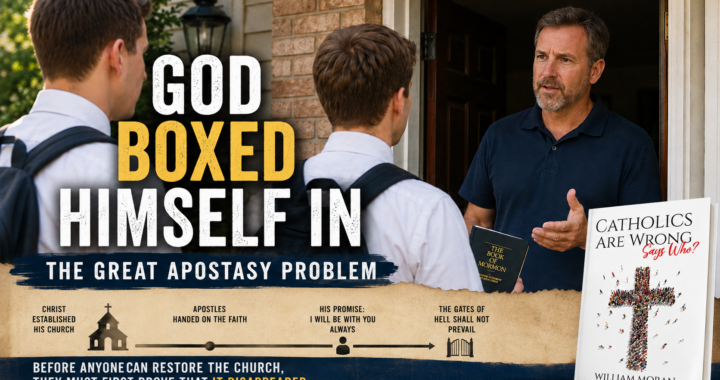
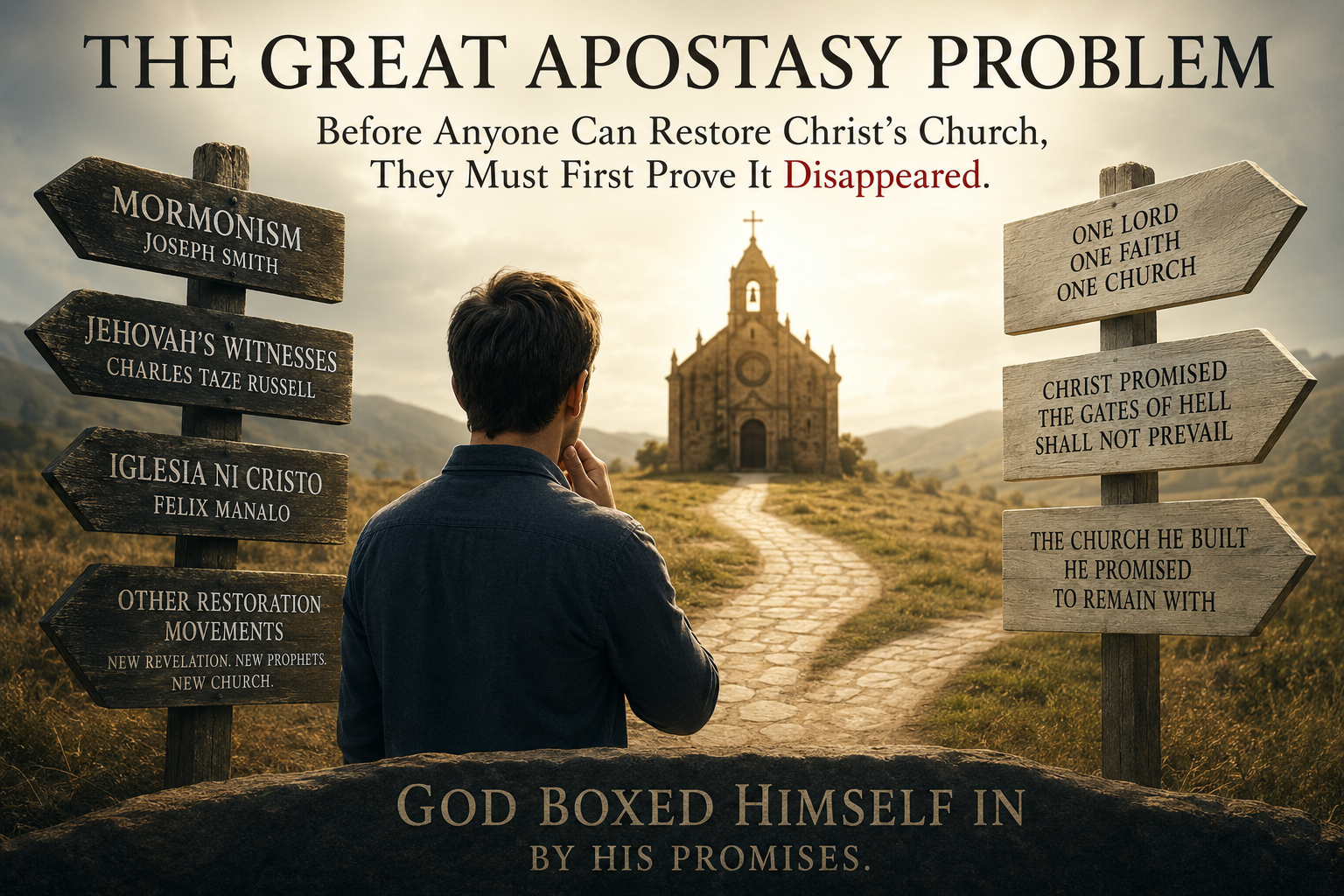
The Great Apostasy Problem: God Boxed Himself In

The problem with the idea of the great apostasy is that it makes Christ a liar. The other day, I heard a knock at the door. When I opened it, two young Mormon missionaries were standing on the porch.

This was not the first time missionaries from the Church of Jesus Christ of Latter-day Saints had visited my home. In fact, I believe this was the third group that had stopped by over the years. One of the young men mentioned that other elders had spoken with me before and then asked what I had been thinking about since their last visit.

That question told me that they probably had some record of the previous conversations, which did not bother me. I appreciated the fact that they had returned. They were courteous, sincere, and clearly believed they had something important to share.

I also knew exactly where I wanted to begin. I told him;

“I still do not have an answer to the Great Apostasy you claim happened,”

That question had remained unresolved after the earlier visits. Mormonism teaches that after the deaths of the apostles, the Church established by Jesus Christ experienced the great apostasy. It gradually fell away. Apostolic authority was lost, essential truths became corrupted, and the true Church eventually disappeared from the earth. According to the Mormon account, God later restored that Church through Joseph Smith in the nineteenth century. But before we can discuss whether Joseph Smith restored the Church, we first have to establish that Christ’s Church disappeared.

That is not a small historical detail. It is the premise upon which the entire restoration story depends. If the Church founded by Christ remained on earth, then there was no need for Joseph Smith to restore it.

This problem is not limited to Mormonism. The great apostasy is believed by Jehovah’s Witnesses, Iglesia ni Cristo, and a variety of independent restorationist movements, which make similar claims. The details differ from group to group, but the basic pattern remains the same. Christ established the true faith, the original Church became corrupted or disappeared, and then centuries later a particular founder, prophet, or organization recovered what had been lost.

Every restoration movement therefore faces the same problem. Before anyone can claim to have restored Christ’s Church, that person must first demonstrate that Christ’s Church actually ceased to exist.

the great apostasyWhen was The Great Apostasy?

I asked the missionary when he believed the Great Apostasy had occurred. He was not sure but seemed to think it may have happened when the early Church councils began. He mentioned the Council of Nicaea and appeared to view it as some type of political gathering that changed Christianity.

I explained that the Council of Nicaea was not simply a meeting of politicians who sat down and invented Christian doctrine. It was a gathering of bishops who came together in A.D. 325 to address a serious controversy over the identity of Jesus Christ. Arius and his followers denied the full divinity of Christ, and the bishops met to defend what the Church had already received and believed. Most interesting about this council is that both sides used a lot of Scripture to make their argument. What we see is the Church exercising its authority.

The emperor Constantine called the bishops together, and political interests were certainly present, but Constantine did not invent the doctrine that Jesus is divine. The debate had already been taking place within the Church.

More importantly, councils did not begin with Constantine.

The first major Church council appears in the Bible itself. In Acts 15, the apostles and elders gathered in Jerusalem to resolve a dispute over whether Gentile converts were required to follow the Mosaic law. They discussed the issue, reached a judgment, and sent an authoritative decision to the churches.

Their letter did not say, “Each believer should read the Scriptures and decide for himself.” It said, “It has seemed good to the Holy Spirit and to us.”

That is the biblical model of a Church council. The leaders of the Church gathered, deliberated, and issued a decision for the Christian community.

The missionary did not seem to have considered the Council of Jerusalem in this way.

The previous Mormon missionaries who had visited me offered a different theory. They thought the Great Apostasy may have occurred shortly after the deaths of the apostles. Yet they had not been able to identify exactly when it happened either.

One group thought it happened soon after the apostles died. Another missionary suspected it may have happened when the councils began. No one could point to a specific event, date, doctrine, or historical rupture.

That seemed strange to me.

If Christ’s Church completely lost its authority and disappeared from the earth, I would expect the evidence to be far more compelling. I would expect restorationists to be able to identify the last legitimate bishop, the generation in which apostolic authority vanished, the teaching that caused the entire Church to become false, or the historical moment when every valid line of succession came to an end.

Where are the Christians living at the time who recognized that Christ’s Church had disappeared? Who announced that the Church no longer possessed the authority given by Christ? What happened that was so dramatic and universal that the entire Christian world lost the Church at once?

The claim is not merely that Christians sinned or that some bishops became corrupt. Catholics already know that happened. It is not simply that political leaders interfered with the Church or that doctrinal controversies arose. Those things are part of Christian history.

Jesus never promised that every bishop would be holy, every Christian would be faithful, or every century would be free from scandal. The presence of sin within the Church does not prove the disappearance of the Church.

The Mormon claim is much greater than that. It requires us to believe that the Church established by Jesus Christ lost the authority Christ had given it and then remained absent from the earth for approximately eighteen centuries.

A claim that large requires more than a vague theory about Constantine or a hunch about Nicaea. It requires clear and demonstrative evidence.

The missionary did not have it.

“God Is Not Boxed In”

As the conversation continued, he explained that revelation did not end with the apostles. God could continue revealing new scripture, appoint new prophets, and speak through others as he did with Joseph Smith.

Then he said, “God is not boxed in.”

I understood what he meant. He believed I was placing an artificial limitation on God by saying that public revelation had been completed in Christ and entrusted to the apostles. Since God can do anything, he reasoned, God could reveal another book, choose another prophet, and restore the Church in the nineteenth century. So I responded,

“God boxed Himself in.”

He looked shocked. He almost gasped. He could not believe what I just said.

The phrase was intentionally provocative. I was using his own words to interrupt the usual way of thinking about the subject. I was not suggesting that some outside power had placed a restriction upon God. I was saying that God freely bound Himself through His own promises. God does not lie. God does not contradict Himself. God does not make a covenant, give His word, and then quietly abandon it.

When God promises something, He remains faithful to that promise. Faithfulness is not a weakness or limitation. It is a perfection. That is what I meant when I said that God boxed Himself in.

Christ Promised to Remain With His Church

Jesus did not simply gather a loose collection of believers and leave everyone to follow private inspiration. He established a Church, gave authority to the apostles, and promised to remain with them. He told Peter,

“You are Peter, and on this rock I will build my church, and the gates of Hades shall not prevail against it.”

Before ascending into heaven, He told the apostles, “I am with you always, to the close of the age.”

He also promised that the Holy Spirit would remain with them forever.

These were not temporary promises. Jesus did not say that He would remain with His Church only until the last apostle died. He did not promise that the Holy Spirit would guide Christians for a few generations and then disappear. He did not say that the gates of hell would fail to prevail until the Church began holding councils. He promised to remain with His Church until the end.

The Great Apostasy claim therefore raises a much larger question than whether some Christians departed from the faith. If the entire Church lost its authority, abandoned the truth, and disappeared from the earth, what happened to Christ’s promises?

Either Christ preserved the Church He established, or He did not. If He did, then the great apostasy is a great fantasy to justify other religions.

The Apostles Prepared for Continuity

The New Testament does not present the apostles as men who expected their authority to vanish with their deaths. They appointed other men, laid hands on them, and instructed them to appoint still others.

When Judas died, the apostles selected Matthias to take his office. Paul and Barnabas appointed presbyters in the churches they established. Paul reminded Timothy of the gift he had received through the laying on of hands and instructed Titus to appoint presbyters in every town.

Paul also told Timothy to entrust what he had received to faithful men who could teach others.

That passage contains several generations of transmission: Paul teaches Timothy, Timothy entrusts the teaching to faithful men, and those men teach others.

This does not sound like a Church preparing to disappear. It sounds like a Church deliberately preserving and transmitting apostolic teaching and authority from one generation to the next.

The early Christians understood that the faith received from the apostles was to be guarded and handed on. The authority of the Church did not depend upon the apostles remaining physically alive forever. It continued through the men they appointed.

What Prevents Anyone From Making the Same Claim?

The missionary believed that Joseph Smith was a prophet because God had revealed new truth to him.

So I asked what I thought was a simple but necessary question.

“What prevents anyone from making the same claim?”

Joseph Smith said God spoke to him. Muhammad claimed to receive revelation. Ellen White (Seventh-day Adventist Church) reported prophetic visions. Throughout history, many religious founders, teachers, and independent preachers have claimed that God gave them a special message. Some said the original Church failed. Others claimed the Bible was corrupted. Others taught that God had chosen them to restore the truth. The problem is that these revelations contradict one another. They cannot all be true.

How, then, do we determine who is genuinely speaking for God?

A person cannot establish that he is a prophet merely by announcing that God told him he was a prophet. The claim cannot prove itself. To say that Joseph Smith is a prophet because Joseph Smith said God revealed to him that he was a prophet is circular reasoning.

The Mormon response often involves praying about the Book of Mormon and seeking an internal spiritual confirmation. Yet sincere people in many religions report powerful spiritual experiences. A person can be sincere and still be mistaken.

Feelings may be meaningful, but they cannot serve as the final authority when competing prophets claim contradictory revelations.

If every person must rely primarily upon an internal feeling, then all of us are left blowing in the wind. One person follows Joseph Smith. Another follows Muhammad. Another follows an independent preacher who claims that God speaks directly through him.

Thankfully, God did not leave Christianity that way.

He established a visible Church. He gave it authority. He promised to remain with it.

That is another sense in which God boxed Himself in. He gave us something outside our private feelings by which competing claims could be tested.

The Great Apostasy, The Church & The Bible

The missionary also suggested that there may be many writings from God that are not found in the Bible. That claim immediately raises another question. How do we know which writings belong in Scripture?

The Bible did not descend from heaven with an inspired table of contents. Many Christian writings circulated during the early centuries. Some were inspired, some were useful but not inspired, and others were rejected.

The Church gradually discerned which writings had been received from the apostles and consistently used in Christian teaching and worship. The canon was recognized through the life and authority of the early Church, including councils at Rome, Hippo, and Carthage in the late fourth century.

The Church did not create Scripture. It identified which writings were inspired.

Restorationist movements often ask us to believe that the historic Church lost divine authority while simultaneously trusting that same Church to preserve and identify the New Testament.

That creates an obvious tension. If the early Church had already become completely apostate, why should anyone trust its judgment about the biblical canon? How can a false and abandoned Church reliably preserve the very Scriptures later used to condemn it?

It is difficult to accept the Bible preserved by the historic Church while claiming that the historic Church had lost the guidance of the Holy Spirit.

The Question The Great Apostasy Forgets

In the end, I returned to the question that had begun our conversation. Before I can believe that Joseph Smith restored Christ’s Church, someone must first show me when Christ lost it.

Not when Christians sinned. Not when bishops disagreed. Not when an emperor became involved. Not when councils gathered.

Someone must demonstrate when the authority established by Christ vanished from the earth. Someone must explain how that happened despite Christ’s promise that the gates of hell would not prevail against His Church. Someone must explain how the Holy Spirit ceased guiding the Church even though Jesus promised that He would remain with it forever.

The missionary did not have an answer.

I did not expect him to change his mind while standing at my door. People rarely abandon an entire worldview during a single conversation. Religious beliefs are tied to family, friendships, personal experiences, identity, and community. Sometimes a person must encounter a question and then live with it for a while before he can begin to reconsider what he has always believed.

I gave him a copy of Catholics Are Wrong, Says Who?

The book explores the same underlying questions that shaped our conversation. Who has the authority to determine what Christianity teaches? Where did that authority come from? How do we know which interpretation is correct? And by whose authority can someone living centuries after Christ declare that the Church established by Jesus disappeared and later had to be restored? He told me that he would read my book and return.

My purpose in giving him the book was not to overwhelm him with Catholic doctrine. It was to give him a way to examine the assumptions beneath the restoration story and the great apostasy at his own pace.

I really hope he will return. My goal was not to insult him, embarrass him, or win a quick argument. The goal was to leave him with one unavoidable question that the great apostasy hinges on.

If Jesus promised to preserve His Church, by whose authority do we declare that He failed?

That question applies not only to Mormonism, but to every movement that claims authentic Christianity vanished until its founder arrived. Iglesia ni Cristo makes a similar claim

Before anyone claims to have restored the Church, that person must first prove that Christ allowed His Church to disappear.

God is not controlled or limited by human beings. But God is faithful to His own word. He established a Church, gave it authority, sent the Holy Spirit to remain with it, and promised to be with it until the end.

In that sense, God boxed Himself in. And thankfully, He did. Because without His promises, His Church, and the authority He established, we would all be left at the mercy of the next person who knocks on the door and says, “God revealed something new to me.”

For readers who have been told that the Catholic Church fell away from the faith established by Christ, Catholics Are Wrong Says Who? takes up the deeper question beneath those accusations: Who has the authority to decide what authentic Christianity is?

Did Jesus Die on Wednesday? Understanding the “Two Sabbaths” Theory

Was Jesus really in the tomb for a full three days and three nights?

If so, how does this square with his death on Friday and resurrection on Sunday?

Did Jesus die on Wednesday or Friday? Some modern interpretations claim that Jesus actually died on Wednesday and not Friday, according to the tradition of the Christian Church. So why the discrepancy?

The so-called “two Sabbaths” theory has gained attention for attempting to reconcile the Gospel accounts with Jesus’ statement that He would be in the tomb for “three days and three nights” (Matthew 12:40). At first glance, it sounds compelling.

Was Jesus really in the tomb for a full three days and three nights? If so, how does this square with his death on Friday and resurrection on Sunday?

But when we step back and ask the more important question—who has the authority to interpret Scripture?—the issue becomes much clearer.


What Is the “Two Sabbaths” Theory?

The theory argues that:

  • Jesus was crucified on Wednesday, not Friday

  • There were two Sabbaths that week:

    • A “high Sabbath” (Passover feast day)

    • The regular weekly Sabbath

  • This allows for a literal 72-hour period in the tomb

It attempts to harmonize several passages:

  • Matthew 12:40 → “three days and three nights.”

  • John 19:31 → mentions a “high Sabbath.”

  • Mark 16:1 and Luke 23:56 → women buying and preparing spices

On paper, it appears to solve a problem. But only if we assume the problem exists in the first place. There is no problem to solve when we understand the Jewish Idioms. 


The Key Mistake: Reading Scripture Like a Modern Timeline

The entire argument hinges on one assumption:

👉 That “three days and three nights” must mean exactly 72 hours. But this is not how time was understood in the Jewish world.

Jewish Idiom Matters

In biblical language:

  • Any part of a day counts as a full day

This is seen throughout Scripture.

So the traditional timeline:

  • Friday (Day 1)

  • Saturday (Day 2)

  • Sunday (Day 3)

…fully satisfies the expression “three days.” The problem isn’t the Gospel. It’s the lens we’re using to read it.


What About the “High Sabbath”?

Yes—John 19:31 refers to a “great” or “high” Sabbath.

But this does not require two separate Sabbaths.

In Catholic understanding:

  • The Passover Sabbath coincided with the weekly Sabbath that year

  • Making it a particularly solemn Sabbath, not a second one

So there is no need to insert an extra day into the timeline.


Do the Gospels Contradict Each Other?

Not at all. The accounts of the women and the spices are often misunderstood.

A straightforward reading shows:

  • Friday: Jesus is buried before sunset

  • Saturday: the women rest (Sabbath)

  • Sunday morning: they return to the tomb with spices

Each Gospel highlights different details—but they complement, not contradict, one another.


The Real Issue Isn’t the Timeline

This is where the conversation gets more important. Because ultimately, this is not about Wednesday vs. Friday.

It’s about authority.

Who determines the correct interpretation of Scripture?

  • Individual readers?

  • New theories on the internet?

  • Or the Church that preserved, canonized, and transmitted the Bible?

This is the question most people never ask.


What Has the Church Always Taught?

From the earliest centuries, Christians across the world have consistently held:

  • Jesus died on Friday (Good Friday)

  • Jesus rose on Sunday (Easter Sunday)

This belief is not random.

It is:

  • Rooted in apostolic tradition

  • Confirmed by the early Church Fathers

  • Preserved in the Church’s liturgical life

For 2,000 years—across cultures, languages, and continents—the timeline has remained the same.


Why This Matters

The “two Sabbaths” theory tries to solve a perceived contradiction.

But in doing so, it introduces a much bigger problem:

👉 It assumes that the Church got it wrong for 2,000 years.

And that only now—through modern reinterpretation—we’ve finally figured it out.

That’s not just a claim about chronology. That’s a claim about authority.


Conclusion

Jesus dying on Wednesday instead of Friday is a creative theory that raises interesting questions.

But it ultimately fails to account for:

  • Jewish ways of measuring time

  • The unity of the Gospel accounts

  • The consistent teaching of the Church

When we interpret Scripture within the living tradition of the Church, the timeline is not confusing at all. It is clear, consistent, and deeply meaningful:

👉 Christ died on Friday.
👉 Christ rose on Sunday.
👉 On the third day—just as He said.


Did Jesus Die on Wednesday or Friday?

If this question challenged you, it should. Because, as with all other questions about Christianity, it leads to the most important question of all:

👉 Who has the authority to interpret Christianity?

That’s exactly what I tackle in my book:

Catholics Are Wrong… Says Who?

Instead of getting lost in endless debates over doctrines, this book goes deeper—revealing the one question that actually settles them all.

👉 Get your copy here: Catholics Are Wrong 

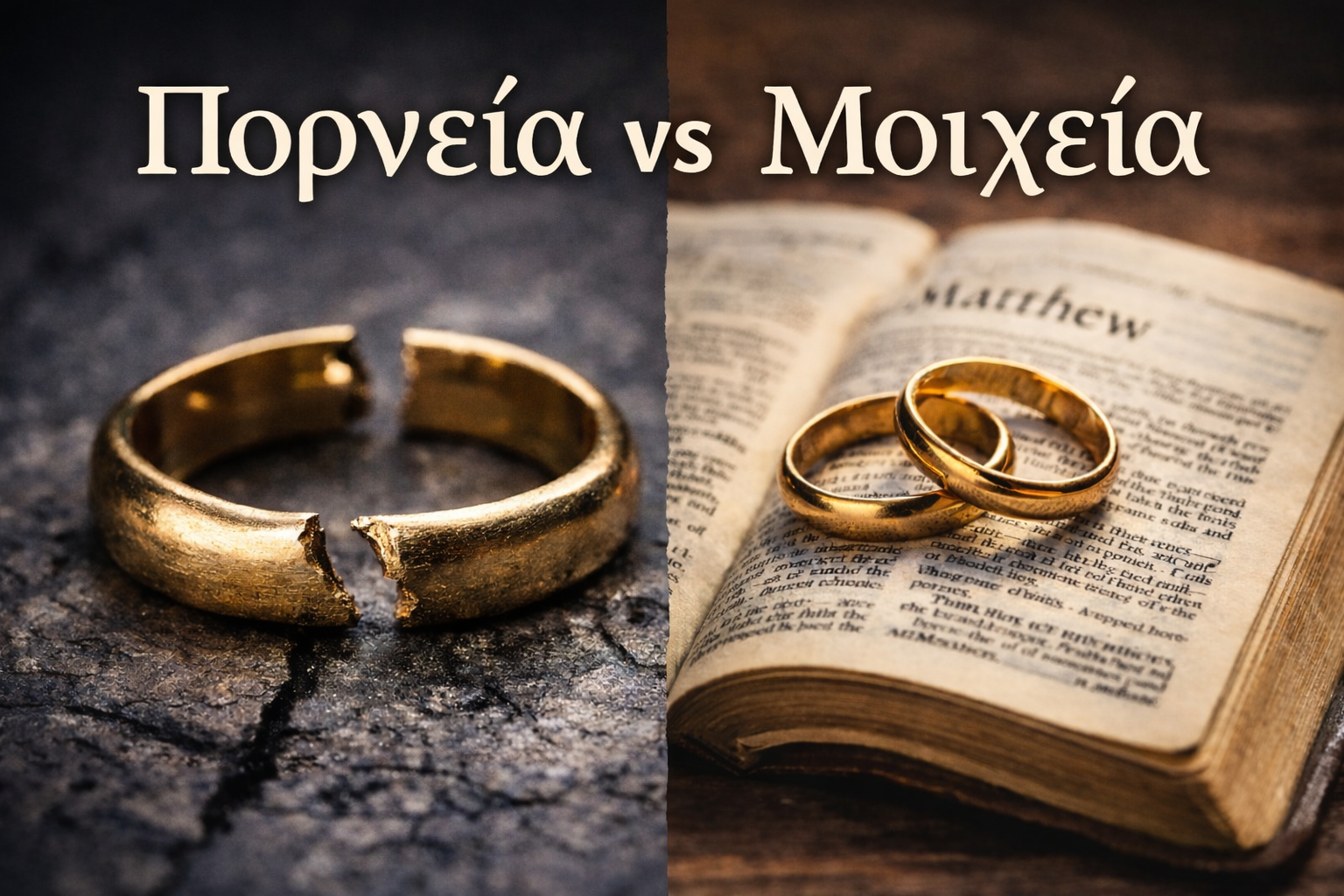
Did Jesus allow divorce for adultery? Broken wedding ring next to Bible illustrating biblical teaching on marriage and divorce

Did Jesus Allow Divorce for Adultery?

Recent news about an alleged affair involving South Dakota governor Kristi Noem and political strategist Corey Lewandowski has sparked a familiar debate among Christians: Did Jesus allow divorce for adultery? Or has this teaching been misunderstood over time?

Marriage and divorce remain among the most debated topics in Christianity. Many people assume the Bible clearly teaches that divorce is allowed when a spouse commits adultery. In fact, this belief is common in many Christian churches today.

However, when we examine the biblical passages more closely—along with the Greek language used in the New Testament and the early Christians’ historical interpretation—the issue becomes more complex.

Did Jesus actually allow divorce for adultery, or has His teaching been misunderstood?

To answer this question, we must carefully examine the passages in which Jesus addresses divorce.


Jesus’ Teaching on Divorce in the Gospels

Jesus speaks about divorce directly in several places in the New Testament:

  • Matthew 5:32

  • Matthew 19:3–9

  • Mark 10:2–12

  • Luke 16:18

When the Pharisees asked Jesus whether divorce was permissible, He did not begin with legal arguments. Instead, He pointed back to the creation account in Genesis.

Jesus said:

“Have you not read that He who created them from the beginning made them male and female… Therefore what God has joined together, let no man separate.” (Matthew 19:4–6)

By returning to creation, Jesus emphasized that marriage was designed by God to be a permanent union between husband and wife.

This teaching was radical in the ancient world. In first-century Judaism, some teachers allowed divorce for trivial reasons. One well-known rabbinical school even permitted divorce if a wife spoiled a meal.

Jesus rejected this cultural norm and restored marriage to its original dignity and permanence.


Why Many Christians Believe Jesus Allowed Divorce

Despite Jesus’ strong statements about the permanence of marriage, many Christians believe He allowed divorce in certain circumstances. This belief comes primarily from the Gospel of Matthew.

In Matthew 19:9, Jesus says:

“Whoever divorces his wife, except for sexual immorality, and marries another commits adultery.”

Most modern Bible translations render the Greek word porneia as “sexual immorality.” Because adultery is a form of sexual immorality, many readers conclude that Jesus allows divorce when adultery occurs.

Under this interpretation, Jesus’ teaching is understood as follows:

  1. Marriage is intended to be lifelong.

  2. Adultery represents a serious violation of the marriage covenant.

  3. Because the covenant has been broken, the innocent spouse may divorce and remarry.

Many Protestant traditions also refer to 1 Corinthians 7:15, where the Apostle Paul addresses situations in which an unbelieving spouse abandons a believer. Some interpret this passage as allowing divorce in cases of abandonment.

As a result, many Protestant churches recognize two possible grounds for divorce:

  • adultery

  • abandonment by an unbelieving spouse

This interpretation became especially influential during the Protestant Reformation, when reformers such as Martin Luther and John Calvin argued that Scripture allows divorce under certain circumstances.


Greek words porneia and moicheia used in Matthew 19 discussing divorce and adultery.

Porneia vs Adultery: Understanding the Greek Words

Understanding the Greek word porneia is central to interpreting Matthew 19. The debate about divorce in Matthew’s Gospel ultimately centers on the meaning of a single Greek word: porneia.

In the New Testament, two different Greek words are used when discussing sexual sin.

Moicheia (μοιχεία)
This word specifically refers to adultery, meaning sexual relations between a married person and someone who is not their spouse.

Porneia (πορνεία)
This word has a broader meaning and refers to sexual immorality or illicit sexual relationships.

The key detail is that Matthew records Jesus using the word porneia rather than moicheia.

Because of this distinction, some scholars argue that Jesus may not be referring to adultery within a valid marriage. Instead, the term may refer to unlawful unions that were never valid marriages in the first place.

These could include relationships prohibited under Jewish law, such as incestuous unions described in Leviticus 18.

If this interpretation is correct, then the exception clause in Matthew does not refer to divorce after adultery. Rather, it refers to separating from a relationship that should never have been considered a valid marriage.


Why Mark and Luke Do Not Include the Exception Clause

Another important observation is that the other Gospel writers make no exception at all.

In Mark 10:11, Jesus says:

“Whoever divorces his wife and marries another commits adultery against her.”

Similarly, Luke 16:18 records:

“Everyone who divorces his wife and marries another commits adultery.”

These passages contain no exception clause.

This raises an important question: if Jesus clearly allowed divorce for adultery, why would two Gospel writers omit such a crucial qualification?

One possible explanation is that Matthew’s reference to porneia addresses a specific situation relevant to his audience—namely, unlawful unions that were not valid marriages. Mark and Luke, writing for different audiences, simply present the core teaching of Jesus: that a true marriage cannot be dissolved.

In this way, the teaching of the four Gospels remains consistent.


How Early Christians Interpreted Jesus’ Teaching

The earliest Christian writers overwhelmingly interpreted Jesus’ teaching as affirming the permanence of marriage.

Church Fathers such as:

  • St. Augustine

  • St. John Chrysostom

  • St. Jerome

All taught that adultery is a grave violation of marriage, but it does not dissolve the marriage bond itself.

While separation could be permitted in serious circumstances, remarriage while a spouse was still living was generally considered incompatible with Jesus’ teaching.

Some early interpreters understood the word porneia as referring to unlawful unions rather than adultery within marriage.


Separation vs Divorce in Christian Teaching

Another important distinction is the difference between separation and divorce.

Christian tradition has long recognized that serious circumstances may require spouses to live apart. These circumstances could include:

  • adultery

  • abuse

  • abandonment

However, separation does not dissolve the marriage covenant.

The spouses remain married even if they no longer live together.

This understanding preserves Jesus’ teaching that marriage is meant to be a lifelong union.


Why Jesus’ Teaching Was So Radical

In the ancient world, divorce was often easy and common, particularly for men. Some Jewish teachers allowed divorce for trivial reasons.

Jesus challenged this cultural norm by returning to God’s original design for marriage.

“The two shall become one flesh.” (Genesis 2:24)

By grounding marriage in creation itself, Jesus elevated it from a social contract to a sacred covenant.


Conclusion – Did Jesus allow divorce for adultery?

Many Christians believe He did because of the exception clause in Matthew’s Gospel. However, when the passages are examined carefully—along with the Greek language and the broader context of the Gospels—the issue becomes more complex.

Jesus consistently emphasized the permanence of marriage and pointed back to God’s original design:

“What God has joined together, let no man separate.”

Understanding His teaching requires careful attention to Scripture, language, and history.

Questions like divorce, marriage, and authority ultimately raise a deeper issue: who has the authority to interpret Scripture correctly? If you’d like to explore that question further, my book Catholics Are Wrong… Says Who? explains why the issue of authority is central to many disagreements in Christianity.

Continue reading→

Did Pope Francis Praise Lucifer? What Really Happened

Every so often, a claim circulates online that is so striking it almost demands a reaction. This is one of them.

“The Pope praised Lucifer.”

It’s not a coincidence that this question tends to come up around Easter, when the Church proclaims the very words that are so often misunderstood.

For many, that statement is enough. It confirms suspicions, raises eyebrows, and seems to validate a deeper uneasiness about the Catholic Church. But before accepting or rejecting it, it’s worth doing something increasingly rare—pausing long enough to ask what actually happened.


Where This Comes From

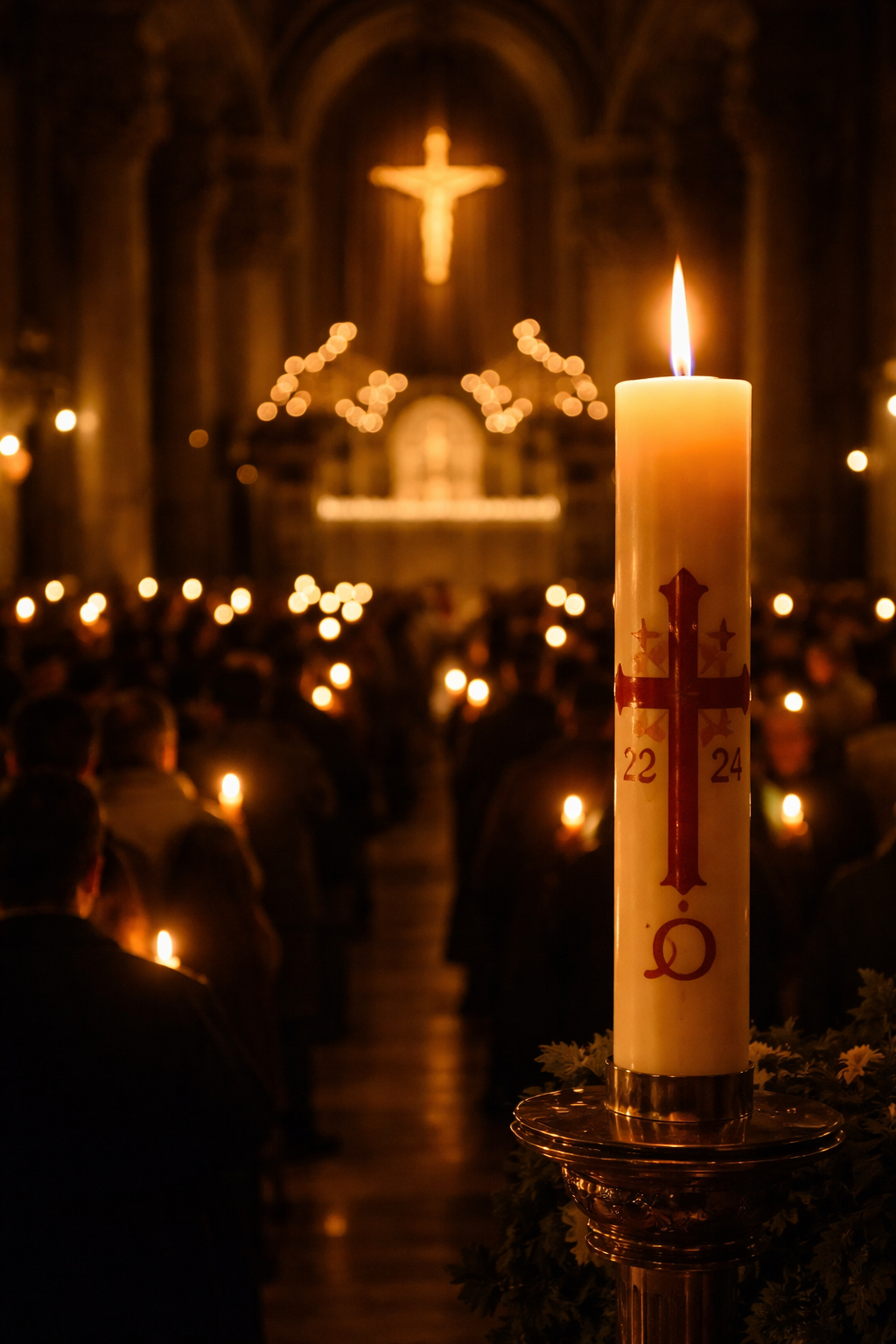
The claim usually traces back to the Easter Vigil, the most important liturgy in the Catholic Church. If you’ve ever attended one, you know it begins in darkness. A single flame is lit, then passed from candle to candle until the entire Church is gradually filled with light.

This isn’t just symbolism for its own sake. It’s meant to communicate something real: the movement from death to life, from darkness to light, from despair to hope.

During that liturgy, the Church proclaims an ancient hymn known as the Exsultet. Christians have been singing it for centuries. And within that hymn appears a word that, to modern ears, sounds jarring:

Lucifer.


Did Pope Francis Praise Lucifer? What Actually Happened

Today, the word “Lucifer” is almost universally associated with Satan. So when someone hears it used in a liturgical context, the reaction is immediate and understandable. Why would that word appear at all?

From there, the conclusion forms quickly: if the word is present, then it must be referring to the devil, and if it’s spoken within the liturgy, then somehow it is being affirmed.

But that conclusion depends on a hidden assumption—that the word has always carried the meaning we assign to it today. Historically, that simply isn’t the case.


Did Pope Francis Praise Lucifer?What “Lucifer” Actually Means

The word Lucifer comes from Latin and, in its original sense, is not a proper name at all. It means “light-bearer” or “morning star.” Long before it became associated with Satan, it was used more broadly to describe anything that brings light.

In early Christian usage, the term was even applied to Christ Himself, precisely because He is the one who brings light into darkness and rises like the morning star. When the Church uses the word during the Easter Vigil, it draws on that older, richer meaning.

In other words, the reference is not to Satan, but to Christ—the one who overcomes darkness, not the one who represents it.


So Why the Confusion?

The confusion comes from reading an ancient text with modern assumptions. Words change over time, sometimes dramatically, and when we ignore that shift, misunderstandings are almost inevitable.

A single word, removed from its historical context and presented in isolation, can easily be misread. Add the speed of social media, and that misreading spreads quickly, often without anyone stopping to ask whether the interpretation itself is sound.


The Deeper Issue

At this point, the question is no longer just about one word in one hymn. It becomes something more fundamental. Who determines what a text means?

When someone claims that “the Pope praised Lucifer,” they are not just making an observation—they are offering an interpretation. And like every interpretation, it rests on an authority, whether acknowledged or not.

This is where the conversation shifts from a misunderstanding to a principle:

👉 Who has the authority to interpret?


Why This Matters

This pattern shows up again and again. Different claims, same underlying issue:

  • Catholics worship Mary

  • The Church added to Scripture

  • The Pope invents doctrine

Each of these statements depends on a particular reading of events or texts. But without a stable authority to guide interpretation, those readings multiply—and often conflict.

Sincerity isn’t the problem. People can be sincere and still be mistaken. The real question is whether there is any reliable way to distinguish between the two.


The Bottom Line

No Pope has ever praised Lucifer. The claim rests on a misunderstanding of language, a loss of historical context, and, more deeply, a confusion about who has the authority to interpret what the Church teaches.

Once those pieces are put back in place, the claim loses its force.


A Better Question

Instead of reacting to isolated claims, it’s worth asking a more foundational question:

👉 Says who?

Who has the authority to interpret Scripture? Who preserves the meaning of what has been handed down? Who decides what is actually being taught?

That question doesn’t just resolve this issue. It clarifies nearly all of them.


Dig Deeper

Most objections to Catholicism feel complicated at first. But more often than not, they trace back to this single issue of authority.

If you want a clear, straightforward way to understand it, that’s exactly what I explore in Catholics Are Wrong? Says Who?—without jargon, and without assuming a theological background.

👉 https://www.catholicsarewrong.com

The Benefits of Lent: A 40-Day Mind and Body Reset

Understanding the Benefits of Lent in History

Lent is a time of sacrifice, but the benefits of Lent are often overlooked. Lent is one of the oldest continuous self-improvement practices in Western civilization.

Christians have observed Lent for over 1,700 years. By the 4th century — especially after the Council of Nicaea in 325 AD — the Church formally recognized a 40-day preparation before Easter. Yet the discipline existed even earlier among believers preparing for baptism and repentance.

Why 40 days?

Because in Scripture, transformation follows preparation:

  • Moses fasted 40 days before receiving the Law

  • Elijah fasted 40 days before encountering God

  • Jesus fasted 40 days before beginning His mission

From the beginning, the benefits of Lent were understood as training rather than punishment. The early Christians believed lasting change required intentional discomfort — something modern psychology is rediscovering.


Benefits of lentThe Spiritual Benefits of Lent: Change by Removing, Not Adding

Lent echoes Christ’s forty days in the wilderness, where He confronted temptation, faced spiritual pressure, and clarified the mission given to Him by the Father. The desert did not weaken Him; it revealed Him. Likewise, Lent is not intended as an annual self-help project or as a symbolic gesture of mild discomfort. It is a small but serious apprenticeship in the way of Christ—a period of recalibration where we empty ourselves of excess so that grace can have room to work.

Most modern self-help focuses on adding habits: new goals, new routines, new productivity systems. Lent works differently. Instead of asking “What should I start doing?” it asks: “What is controlling me?”

The traditional practices shape the person in specific ways:

Practice Spiritual Benefits of Lent
Fasting Freedom from impulse
Prayer Clarity of attention
Almsgiving Freedom from self-absorption

In spiritual language, this is purification. In psychological language, it is attentional retraining. When noise decreases, meaning increases.


Biological Benefits of Lent: What Happens in the Brain

Modern research helps explain many of the biological benefits of Lent.

Your brain runs on reward prediction. Constant stimulation — food, scrolling, entertainment — repeatedly activates dopamine pathways. Over time, the brain becomes less responsive, which manifests as anxiety, boredom, and a lack of motivation. Periodic restraint allows recalibration.

Fasting and Brain Function

Studies on intermittent fasting have shown increased activity in the BDNF (brain-derived neurotrophic factor) system, a protein implicated in learning, mood regulation, and neural growth. Fasting also improves insulin sensitivity and reduces inflammation, both of which are linked to emotional stability and cognitive clarity.

At the cellular level, fasting enhances neuroplasticity and stress resistance in neurons. These biological changes help explain why many people experience mental clarity during Lent.

Resetting Reward Sensitivity

Fasting also influences dopamine circuits — the pathways responsible for motivation and habits. Reduced stimulation increases responsiveness to meaningful rewards rather than to constant, minor stimulation. The brain relearns contrast. People do not experience less—they experience normalcy again.


Psychological Benefits of Lent: Training the Stress Response

Psychology distinguishes two kinds of stress:

Toxic stress — imposed and overwhelming
Adaptive stress — chosen and structured

One of the major benefits of Lent is that it introduces adaptive stress.

Voluntary sacrifice activates the prefrontal cortex — the area responsible for decision-making and emotional regulation — instead of panic circuits. This produces noticeable changes:

  • Greater emotional stability

  • Lower anxiety reactivity

  • Increased patience

  • Improved decision-making

You are not becoming stricter. You are becoming steadier.


Benefits of Lent and Self-Control: How Identity Changes

At its core, Lent is not about giving up; it is about becoming someone new. It is a forty-day immersion in the life of Christ, an annual pilgrimage into the desert that strengthens the soul for the lifelong journey ahead. For the Christian, Lent is not a season of deprivation but of transformation—an invitation to rediscover who we are and whose we are. Every behavior teaches the brain who you are.

Repeated indulgence teaches: “I cannot resist.”

Repeated restraint teaches: “I can choose.”

This is one of the deepest benefits of Lent. Self-control builds self-respect because identity is shaped by repeated actions. Lent shapes character through practice rather than intention alone.


The Benefits of Lent Even for Non-Religious People

The practice works because it aligns with a feature of human psychology: the mind functions best when desire is not constantly gratified.

Modern life quietly teaches the opposite lesson. We remove friction everywhere — food whenever we want it, entertainment on demand, notifications every minute. At first, this feels like freedom. Over time, it produces something closer to mental fatigue. Attention fragments. Emotions become reactive. Small frustrations feel larger than they are.

Psychologists describe the problem in simple terms: when attention is overloaded by constant stimuli, behavior becomes driven by the most immediate cue rather than deliberate choice.

In other words, we stop choosing and start reacting.


How to Experience the Benefits of Lent

Choose one practice from each area:

Body: reduce sugar, alcohol, or late-night eating
Mind: limit social media or background noise
Reflection: five minutes of daily silence
Others: weekly intentional generosity

Even the smallest sacrifices can produce large psychological effects.


The Deeper Meaning Behind Lent

Lent was never meant to make a person miserable; its purpose is liberation. As small sacrifices accumulate, compulsions loosen their grip, distractions lose urgency, and emotional reactions no longer dictate every response. What once felt automatic becomes a choice.

From a Catholic perspective, Lent is not primarily about proving discipline to God, but about making room for Him. The human heart easily fills with noise — not only sins, but constant activity, comforts, and distractions that leave little interior space for grace to be noticed. When the Church asks us to fast, pray, and simplify, she is acting like a wise mother who gently lowers the volume of the world so the soul can hear again.

Many people describe the result as calmness or clarity. In spiritual language, this is the beginning of recollection: the scattered heart gathers itself and becomes capable of attention to God and to others. We discover that peace was not absent; it was merely crowded out.

This is why Lent benefits even those who begin it only as a practical exercise. When we voluntarily accept small deprivations, we relearn that we are not ruled by appetite and impulse. Freedom returns, and with it gratitude. The Christian recognizes this freedom as grace at work through human cooperation—not a dramatic experience, but a quiet reordering of loves. Prayer becomes less forced, patience grows, and ordinary duties feel lighter because the interior resistance has softened.

What starts as restraint becomes relationship: the soul, less occupied with constant consumption, becomes more available to God. In that sense, the calm many people feel during Lent is not separate from the spiritual life; it is often its first doorway.


Final Thought

If comfort alone produced peace, modern society would be the happiest in history. Instead, we are restless. The benefits of Lent reveal a paradox confirmed by both science and experience:

What you voluntarily surrender no longer controls you.

For more on mental health and spiritual growth, visit: Bill-Moran.com — psychology and counseling insights

Anti-Zionism vs Antisemitism: A Catholic Explanation

A Catholic Moral Distinction About People, Politics, and Human Dignity

The question of anti-Zionism vs antisemitism has become one of the most debated moral and political issues today. Public discussion often treats opposition to Zionism and hostility toward Jews as if they were identical. For Catholics, this creates confusion. We must defend human dignity and reason carefully about political questions.

Public debate often treats two ideas as identical: opposition to Zionism and hostility toward Jews. For Catholics, this creates confusion. We must defend human dignity and reason carefully about political questions. The Church calls us to reject prejudice absolutely, yet it also permits legitimate moral evaluation of political arrangements. To understand the issue clearly, we must distinguish between a people and a political project.


anti-zionism vs antisemitism catholic explanationAnti-Zionism vs Antisemitism: The Church’s Teaching

The Catholic Church has repeatedly condemned antisemitism. Jews are not merely a social group or voting bloc; they are a people uniquely tied to salvation history. Christianity emerges from Israel — from the covenants, the prophets, and Christ according to the flesh. Because every human person bears the image of God (imago Dei), hatred directed toward Jews as Jews is a grave moral evil.

This point is not optional or political — it is theological.
A Catholic cannot despise Jews and remain faithful to Catholic moral teaching.

Therefore, violence against Jews, collective blame, conspiracy theories about Jewish control, or denying Jews equal dignity among nations are morally indefensible. When criticism targets Jewish identity itself, it is antisemitism.


A Brief Historical Background of Zionism

Modern Zionism emerged in late-19th-century Europe, primarily through the writings of Theodor Herzl and other Jewish intellectuals responding to persistent persecution and exclusion within European societies. It was not originally a purely religious movement but a nationalist one, shaped by the same currents that produced Italian, German, and Balkan nationalisms. Many early Zionists were secular and envisioned a political refuge where Jews could live safely as a people among the nations.

The movement gained urgency after repeated pogroms and ultimately the Holocaust, which profoundly influenced international support for a Jewish homeland and contributed to the establishment of the State of Israel in 1948. Thus, Zionism developed less as a doctrinal claim of Judaism and more as a modern political solution to a historical problem: the recurring vulnerability of Jews living as minorities in various states. This history shows why Zionism belongs to political history, not theological necessity. Understanding anti-Zionism vs. antisemitism requires recognizing this historical distinction between a people and a political movement.


Anti-Zionism vs Antisemitism in Political Philosophy

Zionism, therefore, is not identical to Judaism. It is a political claim: that the Jewish people ought to possess and maintain a sovereign nation-state in a specific territory. That question belongs to the realm of political philosophy and prudential judgment, not dogma.

Catholic social teaching does not teach that any religious group must possess a territorial state to practice its faith or preserve its identity. The Church herself exists in every nation without requiring political sovereignty. Protestants, Orthodox Christians, Muslims, Hindus, and Buddhists likewise live their religious lives without possessing a universal state defined by their religion. A people’s dignity does not depend on possessing borders.

Because of this, evaluating a state — its legitimacy, policies, borders, or founding ideology — is morally different from evaluating the worth of the people associated with it. We can morally analyze political entities. We never judge human dignity that way.


The Influence of Protestant Soteriology on Modern Perceptions

Many evangelical Christians support the modern State of Israel for theological reasons rooted in dispensationalism, a nineteenth-century interpretive framework popularized by John Nelson Darby and later the Scofield Reference Bible. Within this view, the biblical promises to Israel remain territorially and nationally binding in salvation history. A restored national Israel therefore becomes an expected stage preceding Christ’s return, and political developments involving Israel can take on theological significance.

Because of this framework, some Christians understand the existence and preservation of a Jewish state as part of the unfolding plan of redemption. Support for Israel is not merely political but religiously motivated, since prophecy is read as requiring a national restoration prior to the culmination of history.

Catholic theology approaches salvation history differently. The Church teaches that the promises to Israel find their fulfillment in Christ and extend universally through the people of God rather than through a particular political state. Catholics may prudentially support or oppose political arrangements in the Middle East for moral or humanitarian reasons, but they are not doctrinally bound to affirm any modern nation-state as necessary for the redemption of history. For that reason, some traditions treat disagreement over Zionism as doctrinal, while Catholic reasoning treats it as political.


Anti-Zionism vs Antisemitism: Criticism vs Prejudice

Catholic moral reasoning consistently distinguishes between persons and institutions. Catholics themselves regularly insist on this principle: one may criticize actions of the Catholic Church without hating Catholics. Likewise, one may question the justice or prudence of a government without denying the humanity of its citizens.

The same logic applies here. A person may support, oppose, or partially agree with Zionism for historical, legal, or ethical reasons. Such disagreement, by itself, does not constitute antisemitism. The decisive question is simple: what is being criticized? If the target is a government, borders, military actions, or political theory, it is political discourse.

  • If the target is Jews as Jews, it is prejudice.

The difference is moral, not semantic.


When Anti-Zionism Becomes Antisemitism

The boundary becomes clear when political language turns into collective accusation. Anti-Zionism becomes antisemitic when it denies Jews equal dignity, excuses violence against them, treats Jews worldwide as morally responsible for a government’s actions, or rejects their right to live in safety among nations.

At that point, the argument is no longer about a state. It is about people — and therefore morally wrong.


Anti-Zionism vs. Antisemitism: A Catholic Approach

Catholic thought resists two extremes:

  • claiming any criticism of Israel is antisemitic

  • disguising hostility toward Jews as political analysis

Catholic teaching distinguishes sharply between the Jewish people and modern political arrangements. The Second Vatican Council affirmed that Jews remain beloved by God and rejected all forms of antisemitism (Nostra Aetate 4). The Catechism likewise teaches that God’s covenant with the Jewish people has never been revoked (CCC 839–840). At the same time, the Vatican clarifies that the modern State of Israel is not interpreted as a direct theological fulfillment of biblical prophecy (The Gifts and the Calling of God Are Irrevocable §23).

For this reason, Catholic theology does not require adherence to any political position regarding Zionism while still demanding respect and protection for Jewish persons everywhere. The Catholic moral tradition instead insists on two principles held together:

  1. Every Jewish person possesses inviolable dignity and must never be hated or threatened

  2. We should morally evaluate political arrangements according to justice and the common good

Keeping these together protects both charity and reason. We defend persons absolutely while debating politics rationally.


Conclusion

From a Catholic perspective, antisemitism is always immoral. Political disagreement over Zionism falls within the scope of prudential judgment. What matters is not criticizing Israel, but targeting Jews themselves. Properly distinguishing anti-Zionism vs. antisemitism protects both truth and charity.

The Gospel commands Christians to love both truth and neighbor. When we carefully distinguish people from political systems, we honor both.